
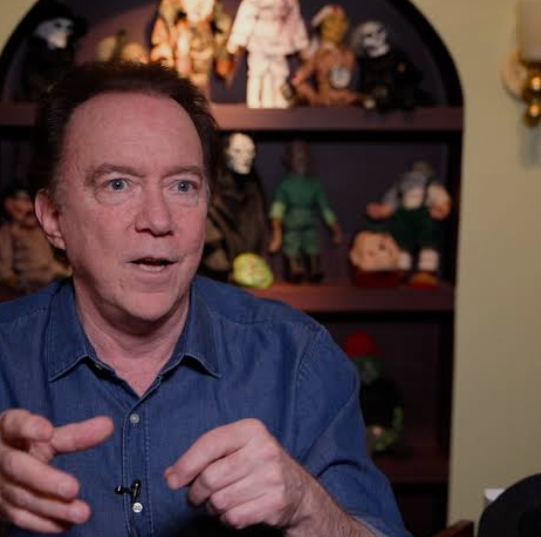
After her impressive documentaries that have previously looked at Found Footage and J-Horror, director Sarah Appleton turns her inquisitive eye on B-Movie producer extraordinaire Charles Band with FULL MOON RISING. Taking an in-depth look at Band’s role as producer from the 1970’s to the present day, with incisive commentary from his family, collaborators, John Carpenter and Alan Jones among others, this documentary also offers an illuminating look at the changing face of low budget genre filmmaking over the years. Sarah chats with Gore In The Store to discuss how she came to be introduced to Band’s vast body of work, the man himself and what informs her own choices as a documentary filmmaker.
GORE IN THE STORE - Why did you choose Charles Band for your next documentary?
SARAH APPLETON - Well the thing about documentaries is that, especially if you think of ones about certain people, you kind of have to already have some sort of connection with them, because people won't just generally want some random person coming in and invading every like space in their life to to find out all their deep dark secrets and things like that. So the thing with Charlie is that back from when I was a kid, my parents run this publishing company called Hemlock Books, and they published the book called Empire of the ‘B’s: The Mad Movie World of Charles Band, which was about Empire Pictures. So I always knew about him, and I had this sort of vague connection with him. I make Blu-ray extras and special features and things like that, and in 2024, 101 Films, a Blu-ray label in the UK, just signed loads of Full Moon films and asked me to basically go and make special features for them. So I reached out to Charlie and everyone basically, and then went to LA and met and filmed with them and and realized how much of a crazy and also very massive story Charlie's life is. He's just gone through so many different eras, and no one had ever done that before. So I thought, why? This guy is so interesting, and it needs to be done basically. I think he's very underrated or underappreciated at the moment, for whatever reason.
And what was his reaction when you proposed it to him?
SA - Well, he's very big on self promotion, so he was happy to originally do all the interviews for his own films and things like that. But when I came up with the idea of doing this documentary about him I went through this guy called Chris Alexander, who works at Full Moon and has a close relationship with Charlie, and he sort of had to convince him that I'm trustworthy. I think they've had issues in the past with somebody else trying to make a documentary about him, and then it not happening, and so he was very reluctant to let somebody else in. So it took a bit of convincing, actually. But then he sort of trusted Chris's recommendation of me. So it went from there, and he was just a very trusting person.
When did you first become aware of Charles Band, as a film viewer?
SA - I think I honestly heard of him just because of the book The Empire of the ‘B’s, and knowing that my parents were publishing that and having a look at it, and that's how I heard of his name. When it comes to watching the films, to be honest, I had probably watched the Stuart Gordon films before, RE-ANIMATOR and FROM BEYOND. So I think it was probably from that, realistically. And I had maybe seen PUPPET MASTER as well. I think I'd seen that years and years ago, but realistically, I hadn't seen many of the films until I really started doing these special features and getting involved in the documentary and discovering that there are a lot of really cool films that he's done. I think I'm probably a bit too young to have found those films in the video store, but I'm sure if I was born early, I would have seen all of them.
So, what attracts you to examining people like him and these types of films?
SA - I've always thought about this actually. I've always been quite drawn to people as a subject. I always think people are the most interesting. I sort of did a documentary before about this guy called David Hamilton Grant for Severin, and that was a guy who was elusive. Like I never got to meet him or talk to him, he faked his own death and stuff. It was so weird, but it's very interesting for me to get into why people do things, and with Charlie, it's like why has he continually made a lot of these very low budget films for the last 50 years or whatever? He's just continually doing it, even when everything has completely collapsed around him, he's come back to life. And that for me, was the question: Why is he doing this, and why do more people in the horror genre recognize him for his extremely large body of work? Possibly the largest of anyone!
In the later stages of the documentary, a lot of the directors who have worked with Charles comment on the state of low budget genre filmmaking and how difficult it is now, especially in comparison to the Full Moon studio days. With low budget horror like OBSESSION, and to a lesser extent BACKROOMS with its DIY beginnings, striking such a chord with the public, I was wondering if you had any thoughts on that?
SA - Well if we're talking in general with horror, horror does work on a low budget and that's why people like Charlie can make this stuff on a low budget. When you have something like OBSESSION, or let's say PARANORMAL ACTIVITY, or THE BLAIR WITCH PROJECT, or all these films that were made on a very low budget that then become hugely successful, I'm surprised that the studios don't really learn from that and take more risks and spend more because they don't have to spend that much. They are just under a million dollars, and you could have another hit if you just take a risk on an independent, original script. But they just don't want to spend any money on that stuff most of the time. I'm surprised that OBSESSION happened, but it did, and it is good. I personally thought it was very scary and quite original. It's hard to be fully original these days but when it comes to Charlie, he just does all this stuff with his own money, and whatever money he gets back, he puts into the next film and so on. It just carries on rolling like that. And it's probably just because that is what he loves to do. If anyone had any sense, like studio-wise, it might have been different for Full Moon, and they wouldn't necessarily just continue making their own stuff all the time. But I don't know. I never know why the studios do what they do, apart from obvious sort of money reasons. It's quite sad. I loved BACKROOMS as well, although that was more of a normal sort of horror movie budget but it just exploded. But I think that studios should just take more risks on original stories like that for sure.
You really highlight how much of a golden age it was back in the 90’s for low budget filmmaking. I didn't fully realize until your film how Paramount were such a big part of the funding for filming and everything else. Would anything like that happen again today?
SA - No, because they were relying on the VHS market being very lucrative and making loads of money, and now obviously with streaming, no one knows if they can make any money.
You have made such a name for yourself with your documentaries. Is this something that you plan to stick with for the future, or are you hoping to make inroads into feature films and narrative driven storytelling?
SA - Honestly, it just depends if there's a subject. Another reason why I'm drawn to Charlie is because I also just make my own things, and don't wait for somebody to greenlight it, because I would never make anything if that's what I did. So it does depend on whether your previous project is successful, like whether I will have money to make the next one. I have got an idea for another doc, but we'll see about that. But I have written a fiction script, and I do want to move into fiction. But that's even harder, as you know. I have a producer, Julie Bain. She produced CREEP and TRIANGLE and these hugely successful British horror films. So she's trying to get it going, but it's been years. Whether it's going to happen or not, remains to be seen.
And do you have a dream subject for a documentary?
SA - I have been thinking about doing a documentary about vampires in horror, but it's such a broad subject. That would be sort of a dream because I love vampires. I'm not sure if it would be possible to really do that as one documentary, so I might have to be a bit more specific with that idea. But yeah, maybe.
And do you have any influences, for when you're making your documentaries?
SA - When I first started doing these documentaries, I was very much against watching other documentaries because I was aware that I might be quite easily influenced by other people's styles and things like that. But I don't really think that way anymore. I really love documentaries in general. It's kind of hard to pick out particular inspirations but I really love Werner Herzog's and Adam Curtis' stuff. But that's all very political and esoteric stuff, so it's not really necessarily like I use any of those styles in my work as such. It's just the sort of thing that I'm into. I would like to aspire to make something like Werner Herzog does with his strange documentaries like GRIZZLY MAN. I would love to make something like that, but it's very scary.
This is your fourth film at Fright Fest. Are you looking forward to it, and taking Charlie over?
SA - It's really nice to have him there because it takes the spotlight off me, which is good. He can do some of the talking, but also that's what people presumably are there for because they know about him and his films, and they want to maybe talk to him. So it would be really nice to have that because I have never had that before with any of the previous documentaries, with the people from them really being there, so I think that would be cool.
Iain MacLeod
FULL MOON RISING: THE CHARLES BAND STORY - WORLD PREMIERE
DISCOVERY SCREEN 1, MONDAY 31st