
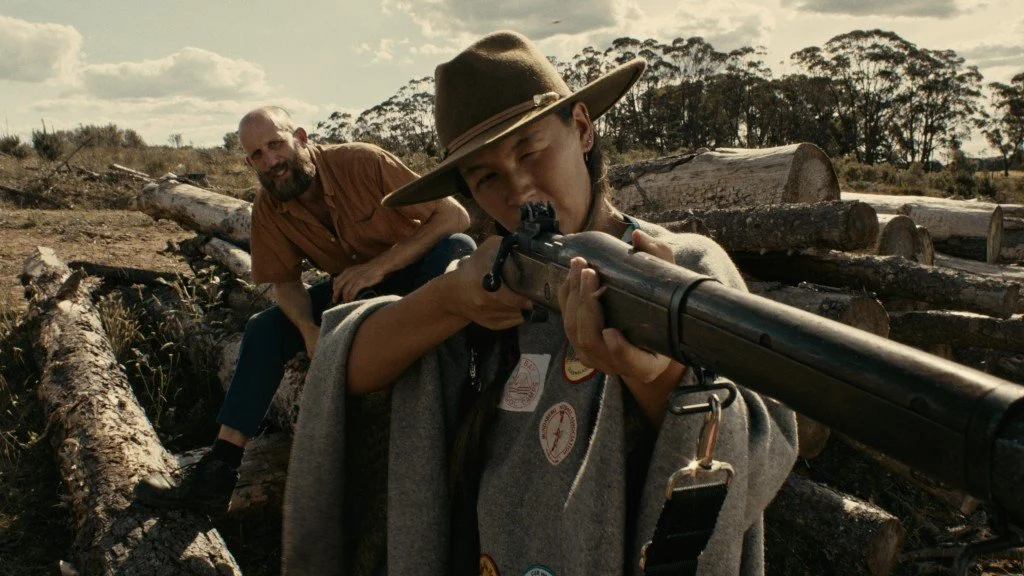
Far more than your typical Australian, post-apocalyptic flick, BUNNY RABBIT is an unsettling, involving and affecting tale that looks at a dystopian world through the skewed eyes of its titular protagonist, played by Kate Wilson. Gore In The Store discuss the film with director James Branson and producer Taylor Thompson, where they chat in-depth about the film's timely, doom-laden nature, Bunny’s subversive role and how Ozploitation and the current resurgence in Australian genre films play into this disquieting film.
GORE IN THE STORE - How does it feel to make something that feels a bit more timely than it maybe should just now, given everything that has been happening in England with the wild fires over the past few weeks?
JAMES BRANSON - England has wild fires? Is that common in England at this time of year?
It’s not common at any time of year!
JB - I've never heard of wildfires in England? That's bonkers! Yeah, I mean... We're all pretty worried, man. I don't know how this thing's going to go, and that's certainly part of the backstory of the film. I think we're seeing a fair bit of post-apocalyptic stuff out there at the moment. It's certainly in the zeitgeist. THE LAST OF US was a pretty big hit and there's a bunch of other post-apocalyptic films that we've come across in the making of our film as well, that have been similarly indie. It's just out there, isn't it? I feel like we've gone from feeling pretty good about things 15 years ago or 20 years ago to feeling pretty grim. Sometimes at some of the screenings of BUNNY RABBIT, people come out and they feel a bit down sometimes because maybe the themes are a little bit depressing. We like to think there's a bit of humor in there as well, but yeah, hopefully, it doesn't come true, but I fear that it might.
TAYLOR THOMPSON - I think the horrifying thing was when we were trying to make a timeline for this, and go, okay, when is this on the timeline? Twenty years? This is not that far away at all. You know, it's like 15 years in the future. The closing song of the film had to be changed due to some licensing, so Andy Golledge, who plays the father, wrote the bespoke track for it, and it is kind of quite jaunty when you are coming out of it, so you have that. You can sit with the tone of it at the end, right? And you can interpret it in lots of different ways. We really wanted something that had that texture and leaves you, maybe feeling really confident about things one way. A lot of people want to discuss what really was happening. But then that jolt of music, I thought was kind of enjoyable.
JB - I did initially want the ending to feel uplifting. That actually, she did the thing that she's been kind of fantasizing about for the entire film, so it ends like it's depressing for everyone else, but it's kind of happy for her.
Australia and post-apocalyptic cinema go hand in hand. Is that something that you were looking to celebrate or subvert?
JB - Certainly to celebrate, man. I'm a huge, huge fan of the post-apocalyptic Ozploitation stuff that came out in the wake of the original MAD MAX. FURY ROAD is my favorite movie of all time. I think partly it's just to do with the fact that the Australian landscape kind of lends itself to that kind of storytelling. You don't need to spend a whole lot of money and time in seeking out anywhere that looks post-apocalyptic in Australia. You go about fifty kilometres out of Sydney, and everywhere looks a little bit post-apocalyptic. Like the last day of shooting the film, it was just me and the cinematographer, and we were just going around looking for places that looked a bit wrecked. And this was in the Blue Mountains, which I don't know if you've been to Sydney before, it's about fifty kilometers west of Sydney, and it's this mountainous region. Everywhere we looked, we found something looking past apocalyptic. I'd walk down a street and see a wrecked car. I'd drive ten minutes away and find this landscape that just looked completely barren and dry and burnt. There's scenes in the film that are set in a bush that's just had a fire go through it. That place is ten minutes away from our place in the middle of Sydney. I think certainly the element of just the locations you have available in Australia lend itself to that kind of storytelling. I think a lot of storytelling comes out of what's available to use. There's this great book actually by David Byrne, the singer of Talking Heads, and it's called How Music Works. And his argument in it is that musical genres, and the way music sounds is very much shaped by the environment that it's performed in. For example, Talking Heads sounded that way because they came up in dingy clubs in New York, so they couldn't have a big sound. It needed to sound quite dry with not too much reverb and shit like that. I think the same goes for any kind of artistic endeavor. It's shaped by the environment that you're in, and the resources that you have. And thankfully, we didn't need to spend tons of money on a CGI budget to make it look post-apocalyptic. We just went down the road.
TT - I also think the lived experience of the 2020 bushfires was pretty wild. That was my first time. I've been in Australia for twelve years, but that was my first experience with having the fires be so impactful. James and I were working in an office building in the middle of Sydney, and we went across the street to have lunch at our usual spot, which is about four levels up on this terrace, and the sky was orange and smoky. And we were this was pre-COVID, so we already had masks on and it was this oppressive sense of doom. And where we shot in Tallong, about an hour and a half south of Sydney, it was very ravaged by the actual bushfires and the cumulonimbus, or mushroom cloud to be more colloquial. They're saying it's the first time it's happened in Australia, where the atmospheric conditions get to a certain pressure to where it can suck up the fire from one place and basically just drop it, two hours away in five minutes and plop it down in another place. And that's when James and I were doing reccies. There's a lot of volunteer firefighters in the local cafes and things, with a lot of iconography, news clippings, and things on the walls. And one gentleman at a pub was a volunteer, and he almost jumped up on a table and told us the entire story of what happened and how the fire cloud was spit down, and this miracle of how one thing was saved and the other thing's gone. So that really spooky lived experience, I think, is naturally infused in the tenor of the film.
How did you both become involved in creating the film?
JB - I've been thinking about making a film for a long time. I shot a documentary about seven years ago that was really interesting, but will never see the light of day because of the behavior of the people in the documentary. I loved the process of making it. I loved doing something bigger than like an ad or a ten minute YouTube video, which is mostly what I was doing before. And so I thought, oh, I'd love to do another documentary, but I wish the people in it would do what I told them to do. Oh, I'll just write a script, and then the actors will do what I tell them to do. So partly it was just a bit of feeling like I had it in me. I felt I'd gained enough experience from a technical point of view and a storytelling point of view. I'd been a journalist and a musician, so I knew how to write and to do music and sound. I just felt ready to do that kind of thing and take on that kind of challenge. So then I wrote the script pretty quickly, and called Taylor, who was a producer at work. And I mean, we were making the film two months after that conversation, we were on set.
TT - It was interesting timing for me because I had moved to Sydney from LA twelve years before. I was producing films, feature and television content in LA. And when I moved to Sydney, which was for love, I think I was a little naive. I don't think anywhere is going to be quite like LA for film and television - not New York, not London, it’s just LA is so unique in that way. I think Sydney at the time, it's caught up a lot in terms of original pieces, I've seen that change over the last 12 years. But what you do when you get over here and you know you're not going to work on Home And Away, or whatever it is for the right time in your career, producing advertising content or things or big TVCs is a really good way to be making a ton of stuff really early in your career. You're going to be making things all the time, with so many different budgets, and it really helped me develop my black book, help me understand how to make lots of different kinds of things, and then having big budgets for big ads is really nice, and it shows you can handle it. But a lot of the stuff I was making with James at a youth media company was a lot more scrappy, and that's a different kind of skill set. How do you take a smaller budget and make it look a lot bigger? So we'd been cutting our teeth doing that, and I think to a point, you're learning and iterating. And I'd gotten to the point where the challenges in that market weren't as satisfying, and I was really going, okay, do I move back to LA and get back into features? I have got a lot of good things going in Sydney though, and I'm ready for the future. I'm ready to get back into it. And then about that same moment, I got that phone call from James, and it was so strange the timing of it. I remember looking at my phone when the message came through, and, like James says, not that long after that, we were up and running.
How did you find Kate Wilson? Did she bring anything to the character that you hadn't considered yourselves?
JB - Oh man, 100% I found her and hired her to just be a bit character in a short film, and just loved working with her. I loved that she really was directable, so you know you give her a note or ask her to change something, and if she would do it, she would understand that. I also love that she's got this kind of withholding vibe on camera. She's a little bit removed. She doesn't emote a huge amount, and her performances are understated, which is the kind of performance that I really love. You see these YouTube videos of the greatest acting performances of all time, and they're just like dudes yelling, which is cool if you like it. But I much prefer an understated performance. Something like Scarlett Johansson in UNDER THE SKIN and Kate certainly brought a ton to it, man. The major thing she actually brought was less dialogue. She has more dialogue in the script, and Kate would often come to me and say, "Look, I just think this character, when she speaks, it should mean something, and the rest of the time she should be pretty silent.” So, most of the dialogue that she had, we really whittled down from something that would be a couple of sentences to something like one word, and that was certainly something she brought. And then she wrote a diary, about Bunny’s entire backstory, which is really cool. She's just an amazing actor. I think she's someone the camera just loves. Her face can convey emotion with a level of subtlety and meaning that even some of the most highly paid actors can't do. I think she's magnificent.
TT - I agree. I think to your point about the journal, the interiority that brings to the character is so great, especially with the restraint. I don't think you get a lot of actors too who are fighting for less dialog and doing so much with it and I think that's wild. She just had such self possession in her prep. She is a delight to work with as well. She has a lot of strong views about how things should be brought to light because she's thought about it for so long, which makes it really fun to build on.
JB - She's also really cool about being covered in blood and then washed off and then having to do it again and then lying in a cold bath for two hours and being pushed around. She's a good sport and she's up for and enjoys that kind of thing, which is important. It's important that the actor actually loves the process of making it.
TT - There are some things that even if you love the process, were a challenge, and she was very generous with us. Going on that journey with Kate to build every little detail in the web out was really great. If I could do it again with a little more time and resources, the rope scenes I would have been able to manufacture something a little easier to get it in and out of, as opposed to like actual practical knots. I would have got a Velcro situation for her for sure, because if you're a little claustrophobic in that, you have to really kind of be patient, and then you know everyone's kind of trying to touch you and getting into it. So I think that's one I would love to build for the next time. I told Kate, if we do it again, I'll build you a quick release.
JB - She definitely didn't like the hair in the mouth. There's a scene where she's having a dream and she's pulling hair out of her mouth. We got two takes out of that, and she's like, "Fuck this!” And then they made me do it at the end of the shoot. I had to put the hair in my mouth.
You mentioned UNDER THE SKIN there, and I might just be going a bit off topic here, but that feels like an ideal kind of comparison with your film, its protagonist, and the things that they do.
JB - If I were to name one movie as the influence on Bunny Rabbit, it would be UNDER THE SKIN. In fact, BUNNY RABBIT was a pretty different story. It came out of me doing this documentary about a cult who do have a feature in one scene in the film. And then I just couldn't quite get the story. I couldn't get past fifteen pages. Then one day, I just randomly watched UNDER THE SKIN for the second time, and five days later, I had the screenplay for BUNNY RABBIT finished. UNDER THE SKIN was deeply, deeply influential, and I think if you do a close watch of both films, as you've kind of said yourself, you can see they're both about a young woman who's quite silent, hunting and killing men.
TT - I think it's really satisfying when you have films in mind that you want to bring forth and people can make certain connections in a way. But also with BUNNY RABBIT feeling so original, that it is really exciting to see people react to that in that way.
You're one of a group of Australian films that are playing FrightFest this year. I've interviewed another couple of directors from Australia, and I've been asking about this new wave of genre filmmaking coming out of the country now. Do you think it is quite different from what came out of the country before?
JB - I think one thing is that the budgets that are available to us are pretty limited in Australia, but there's a level of resourcefulness amongst the filmmaking community that's really high. I think especially over the last 10 years or so, we probably couldn't have made Bunny Rabbit for the budget that we did because we couldn't afford the lights. It would have been a really expensive lighting package, but lighting's gone down from $5,000 for a HMI or whatever you need to like a few hundred bucks for something that's just as powerful and usable and more portable than what you had available to you before. And additionally, cameras have gotten really fucking good, right? Like you can buy a Panasonic GH5, which is a camera from 2017, and you will get a beautiful image out of that camera, and it'll cost you maybe $300. And so I think one thing that's happening, I think, not just in Australia but all over the world, is that independent filmmakers like us have looked at the equipment that's available to us to make a film and go, I can do that now. I think it has a really big impact on both the style and the budget of films that are getting made. The amount of money you need for equipment has gone down to almost zero. So the only thing that's really stopping you is the ability to convince a bunch of other people to come into the bush and shoot something crazy with you for four weeks.
TT - Australia has outkicked its coverage with horror in ways that's nice that it precedes us a bit. The success of other films in the horror space, especially with Gen Z or younger audiences, where they're proving you don't need a big name, we need a concept. We need something that feels like after it's finished, you want to talk about it. You want to discuss it, right? Obviously, there's OBSESSION or BACKROOMS, and those aren’t Australian, but they are genre films, horror films that have grabbed a lot of attention for how they were made in ways that were pretty economic with how quickly they were made. Different approaches and a lot of previs, obviously, which is something I think we did really well in this film. James and our cinematographer did a lot of that. But you're seeing that now, and I think that is helping all the filmmakers within Australia's case even more. We've already had it established in Australia. We are trying to put together some proposals for funding to come over to the festival. You need to make a business case to our screen funding bodies about the business opportunities for the film. And the approved list of festivals, there’s not a ton of genre ones on there, and I had to work to get an exemption for FrightFest in there. I think the business case I put forward was not only do I think it's so important to get FrightFest on the approved list, not just for us, but for all filmmakers. And I went in with that approach. I'm happy to champion that because when it floods, all the boats rise, and I think a lot of what we've been uncovering with Sneaky Films and making BUNNY RABBIT, we need to pioneer, we want to make it easier for other people coming up, and getting us all together to keep it going because the momentum matters, and I do feel that momentum here with genre filmmaking in Australia.
I also want to say thank you so much for the work that you and the other journalists are doing in this space with FrightFest. It's such a cool festival. You know, making a film that you hope as many people can watch and like is one thing, but getting to take the film to a place like FrightFest, where you know the audience is so ready for the art we're making is thrilling.
Iain MacLeod
BUNNY RABBIT - UK PREMIERE
DISCOVERY SCREEN 2, MONDAY 31ST AUGUST