
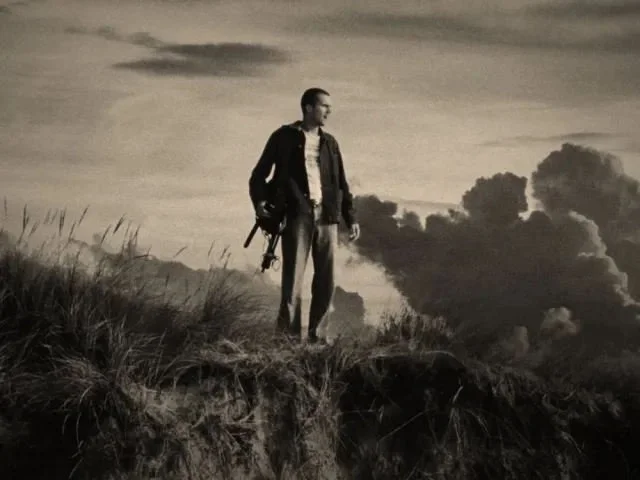
Odd, offbeat and funny, THE PERIL AT PINCER POINT takes a distinctive look at vintage genre film with the tale of sound recordist Jim. Dispatched by his tyrannical director to a remote English island, Jim unwittingly finds himself in the middle of a spectral, sea bound odyssey that recalls the vintage days of pulp genre filmmaking with its singular, vintage black and white stylings. Gore In The Store discuss the film with writers and directors Jake Kuhn and Noah Stratton-Twine in how they crafted the films characters, story and visual ideas as well as their plans for future films.
GORE IN THE STORE - What were your main influences for telling this kind of story, and in the way that you told it?
JAKE KUHN - I mean, the most obvious one is the one that we dedicate the movie to, which is Roger Corman. Which sort of came about in the writing process. When we went away and wrote the script, which was in the town where we filmed it, we also watched a huge marathon of every Roger Corman movie that we could find, which I mean when I say huge marathon, it ended up being maybe like eight movies or something like that. But u we watched ATTACK OF THE CRAB MONSTERS and CREATURE FROM THE HAUNTED SEA.
NOAH STRATTON-TWINE - Wasn't that the same stretch when we watched JOHNNY GUITAR as well? Which has nothing has nothing to do with anything, or maybe it does.
JK - Maybe that came into it too, but yeah, essentially we just watched a bunch of those, and I think we were really compelled because we were also reading Corman’s book, How I Made 100 Movies in Hollywood and Never Lost a Dime. The ethos of that, which was take what you can and go and make something, was really appealing to both of us. And so the whole film sort of stemmed from this idea of like what can we get at our fingertips, and what can we make the film with. The film itself sort of came from the fact that we were filming in this town that was famous for crabbing and for a pint of beer called Ghost Ship, and we were like, right, let’s make a film in this town with a ghost ship and loads of crabs, and just see how it evolves. And that's sort of how the main idea came together purely from those elements, and then we snowballed it into something. I don’t think I would necessarily like to point to one main influence movie wise. I would genuinely say Noah and I really come to cinema from a place of just absolutely loving movies, so I think there's a lot of sort of stereotypes ingrained in our heads. So a lot of people have watched the movie, thankfully, and said that it reminded them of something, and I think that's just because of the sort of stuff we're playing on, it's a little bit WICKER MAN-ny, but that was never a direct influence, it just sort of fed its way in there. There's also elements from a lot of folk horror, like BLOOD ON SATAN’S CLAW, and other movies of that genre and that era as well. But then there's also a little bit of BAIT in there and some more modern influences. There's a whole extended sequence where the main character meets a ghost that I remembered only recently is completely sort of like ripped off from I SAW THE TV GLOW, where we just watched and felt very affected by that and wanted to do something similar atmospherically and sort of bring the movie down a little bit from from the register it was on to a different one. So I think there's just such a hodgepodge of loads of different things in there, without any of it being too intentional, except for the Roger Corman stuff.
NS-T - For me, heading up the post-production side of things, I say proudly, of a team of two or three people, it was when watching HUNDREDS OF BEAVERS that I started to feel like I could access what this film could be. Given I had a little bit of experience in post-production marketing and After Effects work on motion graphics, I was essentially doing the same techniques in a very corporate, boring way, which BEAVERS was doing in the most fun, brazen, ludicrous, enjoyable way. And watching that film and the word of mouth positivity of that movie was giving me permission to say to Jake, I know how to do this. I know that we can go out and shoot these very broad, typically mumblecore-esque stuff, and you know, I feel like we have access to be able to really get specific about what we want shots to be and push it in this very kind of artistic, stylized fashion with these matte painting-esque sort of situations. Then leaning into post-production not as a fix but as a flavor. It's been cool to see, for example this movie last year called OBEX, which we saw after we'd made PINCER, which felt like it's part of the same family. Where you can do these handmade adventure movies, and the lo-fi quality of the effects is actually a boon of the movie. It makes it feel quite comforting in the same way that when you see the scenes of these old sort of 1950’s things, it's nice to see how they did it. It's aged quite poignantly and sincerely. I remember that point in this very room watching BEAVERS with Jake and being activated. But that was mainly from a technical side of things. I didn't know what we could do, but I suppose the best thing to say is it was like what couldn't we do?
You touched on it there, Noah, and it comes across in the film that you both already have worked within “The Industry”, as your hero Jim so proudly calls it.
JK - I definitely have been on sets before as a production assistant and doing office work and things like that. I don't know if this exactly answers your question, but the main thing that made the film so relatable to me is that feeling where you're like, I got into this to be creative and to make stuff, and I really want to help the director, and I'm spending sixteen hour days working toward setting up tables in some room or clearing tables from another room to service someone else's vision. I think it's that sort of feeling of a weird sort of industry mind washing where you suddenly get sort of radicalized into helping this one thing go forward. Which is like a really freeing feeling to be part of a large machine that has such a clear goal, and I think that's fantastic. But you do also find all of your autonomy being sucked out of you as you just service this one big thing. Especially in the film industry, it's one of these industries where when I was nineteen, I was working sixteen-hour days on a set for six days a week, for months straight, and you just find your whole life just becomes that one thing, and it really feels that's the only way that you can do it. I definitely have a lot of friends who have been sucked completely into that, which they're very happy with, but it is a funny feeling. I also felt myself being one of these people who was really similar to Jim, where it was like oh, I want to make movies, but I never actually made anything. So it was a very strange position to be in. It's like that idea of saying you want something and being active, but also being quite lazy in the thing that you actually want to do. And the best thing you can do is basically just get out there and actually go for it and put everything into it.
NS-T - I think, or I hope, you're referring to that joke of Jim going around shouting “I'm in The Industry.” I do think it completely just comes from the fact that I think me and Jake are in a position now that we never even thought of being in, and having conversations that we never thought we'd be in. And I think what I realize now is like the term filmmaker has kind of lost its meaning in a sense, you have to get really hyperspecific. It's so bizarre, so many people go around saying “Oh, I'm in the industry,” and I don't even know what that means. I'm more and more convinced every day that the industry is actually just 10 people, and I think it's just this thing that you go around and so loosely say. So it was really nice that Jack (Redmayne) improvised a lot, but he puts that in as well because I think you must hear that so much being an actor as well, in the conversations that he's having. So it felt so perfect, for him to go to the most far out place ever and telling everyone “I'm in The Industry” as if it actually has some sort of meaning.
And I was wondering if the character of the tyrannical director PW was actually based on anyone that you might have come across yourselves?
JK - Let’s just say it's like a bit of me and a bit of Noah. It's like the internalized version of us as a director.
NS-T - Yeah, I mean, obviously, that's a joke. I don't go around screaming at people. But I could say it's an extrapolation of how I certainly sometimes felt when I was directing short films ten years ago. It's not that I ever behaved in that way, but that's maybe like the mindset that you have early on where you think there's nothing more important than what you're doing right now. I remember being up all night and developing short films for over a year and thinking this is the most important piece of work that's ever going to be made and I have to make sure everyone's on that same level, and you become a megalomaniac about it. So there's obviously parts of that, but on the day it was more of a thing where on the scriptment sort of treatment that we had, it was sort of described as a maniacal director, and a lot of the loose kind of like dialog notions that we had on the page, more the kind of directives and not so much the words around it, but just like the point that PW was getting at. And then Os Leanse, who plays PW, we found out on the day that he was going away he was listening to old tapes of Orson Welles, which we found hilarious because any time an actor on this film took their job seriously, we found it hilarious, which maybe speaks to our PW isms as well.
JK - It's probably a better question for Os because he brought so much to the character in terms of just his own experience. I bet he was just having PTSD flashbacks to various directors over the years who he's worked with who have been very tough. So maybe we'll have to ask him and see and see what he says.
I was very happy to see a no AI Gen sticker on the end credits, and I was just wondering how you actually shot this. Was this shot on film, or were all those effects like the cigarette burns for reel changes all added in post?
N S-T - Everything was added in post. This was a lot of fun for me because most films that I've made, including shorts, I've always kind of lent more towards emulating films. So I've sort of been like self practicing for quite a long time, and this was the first time where I actually kind of got to make the degradation of the simulated film stock like a main character in a way, so it's the way that we shot it. We shot it on a Sony FX 3, and we shot it really simply. Like it was like Murray Zev Cohen, our amazing cinematographer, and one light. We simulate this strange meta bit in the movie at the beginning where we simulate a kind of a B-movie inside our simulation of a B-movie, so how do you double in on yourself? And that was simply doing stuff like putting cloth over the lens to wash out the image even more, and doubling the amount of film stock. So I think technically, I'm using a 16 millimeter film stock for most of the movie, and then I've literally duplicated it, so there's two layers of 16 millimeter emulation on there, and then everything else is sort of pushed up in individual nodes. So there's the grain, there's the halation. We didn't actually have a lot of control because of the software that I was using. It was a free trial that I exploited. It had everything but the watermark at the bottom. So that was good. And those cigarette burns, those cues were actually made in Photoshop. I was trying to make my own ones, and I just couldn't get it right. I think for contemporary audiences, like the way cigarette queues have probably been utilized most recognizably is in FIGHT CLUB. Whenever something's amiss, those cigarette burns happen. So I literally just got a 4K scan of that downloaded, and I just isolated it because of the way it jitters with the frames as well, so it's like a different burn in every frame, and those are the ones in the movie. But we have had some people come up to us after screenings being like, "I know you weren't using film stock because the cigarette burns weren't in the right places.” So be it. But, that's the stuff that's fun for me. Even simulating the gate kind of opening a little bit, after the burn, as the new reel clicks in. I think it's stuff like that which people psychologically just like to take in, and they hopefully won't notice. And just hearing that some people are unsure what is film and what isn’t is the greatest compliment in the world.
The film is set in 2002, and there is a sense of an affinity for old tactile technology, like cam recorders, voice sound recorders and stuff like that. Is that something that you share yourselves as well?
NS-T - Absolutely. I think Jake and I are probably saying analog is king. A lot of it is kind of just aesthetic. We liked the way his silhouette looked with all of these little notches on him and these tape recorders. And I think if you're trying to show someone getting stressed through their work, it's so fucking lame if they're just using Audacity on a laptop screen. Pulling the actual tape is like pulling out your hair in a certain way, and it's like we'd be losers not to show that.
JK - I think from my perspective, there's two elements to this. One is that I think we both agree that the whole movie has a very tactile, handmade quality, and I think that leans much better towards using physical instruments for sound rather than using a laptop. Then there's also this element where we kind of wanted the movie to feel like this crazy dream where bits from different eras all sort of came together to create something where you couldn't quite place it. We wanted this feeling where it's like it could be like 1960. It could be like they're making a movie that's from 1950, and yet, he’s using this old tape system with USB’s, so there's this accumulative effect where it feels so scattered over a huge time period that it feels like something where you're asking, how did this exist? Where did this come from? And I think inside of that, there's this huge sort of dream quality where things have the illusion of making sense without actually making much sense, which I think helps transport you atmospherically into the world of the movie really nicely. And I think filming these things like the mic and the wires and the tape, like Noah's saying, have an aesthetic quality that really grounds the viewer in something. I can’t quite put my words to just what that thing is. It's something that feels like it's got that handmade tactile quality, which is why people respond to film stock as well. Then the second element is obviously the props. We had no money, so I stole all those props from a film school prop house. I literally just went in there and nicked anything that looked remotely old. And we just took wires from different things and used them in ways they shouldn't be used. Or when he's got a pistol grip for his microphone, I remember we taped that on and screwed it so badly together just to make it work, just because we knew he had to have this silhouette almost like a pistol, and so a lot of it is forced together, which I think is a really nice metaphor.
Were there any actual sea legends that you took inspiration from, for this?
NS-T - It’s so lame that a lot of it was just taken from this beer called Ghost Ship that literally has a spectral ship on the label, and whatever legend that artwork is inspired from. But nautical myths? I do have an affinity towards Lovecraft but it was never utilized in this movie. Maybe because I thought we were making an entirely different movie, and in some way we were. And it's that sense of what Jake was talking about earlier, where it's it's been so strange and rewarding seeing people coming out of this movie sort of impose things on it and say it's so nice that you reference this, or we can tell that you've watched this or read this, and we just sort of nod along. We have no idea what they're talking about. But it's like these kind of quiet sensibilities and practices that are already instilled in you in the sense where if you've done the work or research and read the materials years before you turn up on the day it's already in there. It's not something you really have to say out loud, it's going to come out in the work. It's like when you get to a point if you work with the cinematographer for a long time, where the words you're using to describe what you want become less specific and more contextual. You can just kind of say like this is how I want this to feel or this is how I think we should shoot this, and you know the sensibility and the practices enough that it's going to come out more or less the way that you want. We may be being kind of humble to a fault because we might actually be on our deathbeds at some point and remember this really poignant, allegorical thing that the movie was clearly inspired by, but at the moment I think as far as we can say, it's a lot more inspired by our relationship to the the film industry and what it takes to sacrifice to make art in a kind of very silly way.
JK - I don’t know if I have any sea myths that I believe in. I think Noah and I are both huge fans of any of those Greek myths. Like obviously like the Odyssey, not just because it's popular right now!
NS-T - We liked Homer before everyone else was into it.(Laughs)
JK - We grew up with the more fantastical sort of versions of that, like JASON AND THE ARGONAUTS which we both really liked. I definitely think that that tactile, handmade way that they did the Hydra and the skeleton soldiers and all of that is so ingrained in both of our heads that there is that kind of approach to filmmaking where you can do these really fantastical things that have such a fun quality to them. I think that's the thing that I like about any of these myths is that they take a lot of stereotypical elements from stories that are very easy to understand, and then as the myth goes on, they slowly break it down into ways that are very unexpected. I would say it would usually be like a person rocks up on an island, there is the classic old man, he's heeding warnings. There's some prophecy and there's some larger, overlooming mission and idea. It's like all those sorts of things just feed so directly into the sort of movies that me and Noah like to make and want to do. So I think I would definitely just say that, in general, I just like a good myth, and I love a good sort of story along those lines. And what Noah and I are writing at the moment is essentially an Odysseus quest type movie, you know, that same kind of idea of people questing and going out and about. It's such a huge part of life.
NS-T - I will say as well, though, that PINCERPOINT 2 delves into the nautical myth side of things in quite a big way. We have some quite elaborate Atlantean sequences and plots that happen in the sea. So let us know if you've got any myths you like, or we should read up on.
JK - Because we'll take all of them!
Iain MacLeod
THE PERIL AT PINCER POINT - ENGLISH PREMIERE
DISCOVERY SCREEN 2, MONDAY 31ST AUGUST