
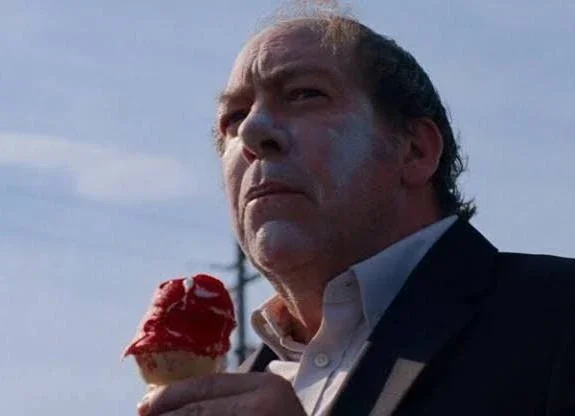
Making its European Premiere in the Main Screen at this years Tubi FrightFest, PONDEROSA is a disquieting and surreal examination of the strange relationship between the disaffected, aimless Zeke (Jack Dylan Grazer) and the much older George (Bill Camp), a rich customer of the titular chain restaurant where Zeke’s mother, Sandra (Alexis Bledel) works. Unsettled by George’s fatherly advice and generous gifts to him and Sandra, Zeke follows along with George’s increasingly odd behaviour, until the unavoidable truth of the rift between these two generations of men reaches a startling breaking point. Gore In The Store discusses this strange, troubling and ultimately affecting film and the issues it raises with writer and director Rob Rice, who goes in depth with the film's themes, visual style and own personal choice of chain restaurant.
GORE IN THE STORE - What was it that gave you the idea for the central conceit of the film about this relationship between these two polar opposites of men?
ROB RICE - Well, I guess I feel a little bit that that kind of generational conflict is in the air in our culture, certainly in the U.S. And I bet you can tell me after, but I bet it's shared across a lot of the world that there's a conflict between the generation that was coming into power in the second half of the 20th century, and the generation growing up in the world that those people built. I think the boomers, in a reductive way, want some kind of validation that the world that they built is good, and the younger generation are not providing it because maybe it isn't the case, but it's all kind of abstract the way that I feel these two generations are in conflict. So I felt maybe that the film could literalize it, or we could learn something about that conflict if we made a kind of parable or an allegory where we literalize those forces into single characters who were kind of representative. So some of the ways we know and some of the ways maybe we don't know that these two generations are battling with each other explicitly, ideologically, libidinally. We could see it better if it was personified in the character of these two men, and so I think that just made it easier to kind of get a handle on what we were dealing with.
And do you feel that you're stuck in the middle of this conflict?
RR - For sure, I feel like I'm at a dinner table and they're arguing across the table, and I'm there, my generation, kind of caught in the middle. I know something about each generation. I grew up in the telltale end of the time where we still believed in the world that the boomers were selling. I grew up at the end of the history era. And then that rug was pulled out from under me, and there was some whiplash that actually that world that they were describing isn't the world that we weren't going to go into the twenty-first century, where Western liberal democracy was going to spread unchallenged around the world, and there was going to be no more conflict. And, actually, that turned out to be exactly the opposite of how the 21st century was going to be. So that rug was kind of pulled out from under me, and I had some self consciousness, or guilt, or shame for having ever believed it. And that whiplash kind of defined my generation politically. So I'm jealous of the generation after me, the Gen Z-ers, for having never believed it, not having been so gullible, or just not ever having been exposed, so they didn't have to be part of this kind of pendulum effect. And so, yeah, I'm between them, and also I think it's interesting to make a film about an argument that's happening between two classes, neither of which you're a part of, so that my own perspective is a little bit more hidden. I think films these days can be a little bit didactic or something, or the hand of the filmmaker is too felt. And of course, I have an opinion, and I think ultimately it's pretty clear what my opinion is. But I think it's nice to make a film about a conversation that's happening between two people, and I'm kind of reserved, keeping my mouth shut, and I like the aesthetic that that engenders.
Talking about aesthetics. I was wondering about the aesthetic of the film itself, why you chose to film in 4:3 in all these stripped back, identikit locations. Was that an idea you had before, when you were writing the film, or did that come up during filming on location?
RR - No, it was a big part of the script. I think this sterilized nothing world that they're building is one of the logical conclusions of what they've been building all along. The alienation of the suburbs and the corporatization and financialization of all aspects of life, food and where we live, how we work and how we relate to each other. This is the kind of final form. It's the lab that they wanted to build, the petri dish they wanted us to live in, so that environment I think is important, partially because of the triumph is that it didn't work, Zeke's generation is not totally docile and de-radicalized. In fact, that sterilized world still has an ambient eeriness and weirdness, and the texture of human life is still going to assert itself out of that world where they tried to stamp it out. I like to portray that world as having failed to totally eradicate community. I think part of why the film works for me is that George is not as coherent as an idea of an ideologue as his friends. If the film was about one of those other guys at the barbecue, who was fully on board ideologically and understood what all that stuff was about, he would be less interesting. George is kind of one of their dumbest evangelists, and that makes him more interesting because really, you just know that he's full of desire for something he can't even put his finger on, but probably some kind of community or belonging and the heartbreaking thing is that it's exactly that which he's working to stamp out, where he's collaborating with those peers of his to eradicate from the world, and that environment that the aesthetic of the film is so invested in is part of that effort. Zeke and Sandra’s house is totally sterile, and all the houses around it look exactly the same. The set design in there is totally blank. We didn't add a lot of lived in feeling or warmth and color. It's kind of like they just moved in. It's just empty in there, and white and kind of ghostly. But I like that eeriness - the absence of something expected. The weird is the presence of something unexpected, and the eerie is the absence of something expected. And I think there's an eerie absence of something, human life or something that that sterilized environment really is evocative of, and so I think it's all related.
Would you call it liminal?
RR - Yeah, the word's been around. I think some people called it a liminal comedy, and I think that's great.
Would you describe it as a comedy or a horror yourself? Or something else?
RR - I think it depends on your constitution as a person in how it strikes you. It's hard to say. I do think of it as very funny, but it's also kind of like if you live with a parent with a disease or something for years, you and they probably laugh about it a lot, and it's a comedy to you, but to other people who are just encountering it, it's a tragedy. You know what I mean? There's some way that I think it's a comedy. I think. I don't know how I feel, but I think that humor is political in a way that is misunderstood or something. It points to the incongruity in things. The movie is about arbitrary common senses or where George's world thinks certain things are natural. Conservatives are obsessed with what's the natural way of things, and all of those ideas are totally arbitrary. And it's often pointing to those arbitrarinesses or incongruities between things that make you laugh, and show you how absurd this is. Look how arbitrary this thing is that he's stating as if it's a fact. And when you laugh, you're admitting that you recognize that almost in an involuntary way. So I think there's something political about humor, and so if I say all of that, then I can say it's a comedy, and I don't feel bad.
Well, I thought it was pretty funny, and I also got quite a fright as well with the scene in the car towards the end. I was wondering if you could talk about two certain figures from the latter half of the film and where they come from?
RR - Yeah, well, kind of like that, liminal, sterile eeriness. I think when you push things so far in that direction, they're bound to break. Or it's like they've pushed us too far into Americanness, and we're going to come out the other side. And I think both of those characters are versions of coming out the other side, or what we're toying with. Like you better be careful of pushing too far in that direction. Because you'll wake up characters like that, and they'll start to emerge into our world. And so both of them are maybe like counterposing figures, or one's fully demonic, and one's a little bit ambivalent. But I think those figures are going to start coming out of the woodwork if we keep going in the direction we're going.
Would these be figures that you would explore again in future works?
RR - I think so. I think they're definitely like visitors who can visit many films.
Like your own abstract MCU.
RR - Exactly, but they only make brief appearances, and the whole thing is kind of just glanced.
I did get the sense that the person in the post credits was a bit of an overseer.
RR - I call him the Sensing Man. I like him because it's kind of like architectural in a way. The film’s about houses and then he's there after the credits so it feels a little bit like he's in the basement, like he's down below everything, like in a video game rendering, and there's the architecture. That's where he lives.
Before we go, I do have one more question. What is your own favorite chain restaurant?
RR - Wow, that's a good question. Man, I should have been prepared. Recently I've been loving a place called Texas Roadhouse, which I would recommend if you're in the States, you should check it out. I had a Ponderosa in my town growing up that has since closed. Like almost all of them have closed, but Texas Roadhouse is certainly alive and well. It's a very strange place, and a lot of peripheral people from my high school all work there and are very proud of working there. Those people that Facebook, for whatever reason, keeps you up to date with. Seems like half of the people that Facebook has selected for me to know about all work at Texas Roadhouse, and so I've gone a few times. And it's actually a pretty good place. Check it out.
Iain MacLeod
PONDEROSA - EUROPEAN PREMIERE
TUBI MAIN SCREEN - FRIDAY 28TH AUGUST, 3:25 PM