
IN CONVERSATION WITH RICHARD E. WILLIAMS
Australian writer and director Richard E. Williams travels to FrightFest with DEAD EYES. Telling the tale of a young man’s search for his father and his disturbing medical experiments, Williams brings a literally fresh perspective entirely through the POV of its protagonist. Chatting with GORE IN THE STORE ahead of the films FrightFest UK premiere, Richard discusses his approach to storytelling, influences and the new wave of Australian genre filmmaking.
GORE IN THE STORE - What came first? Was it the idea for the story itself, or the way that you tell the story?
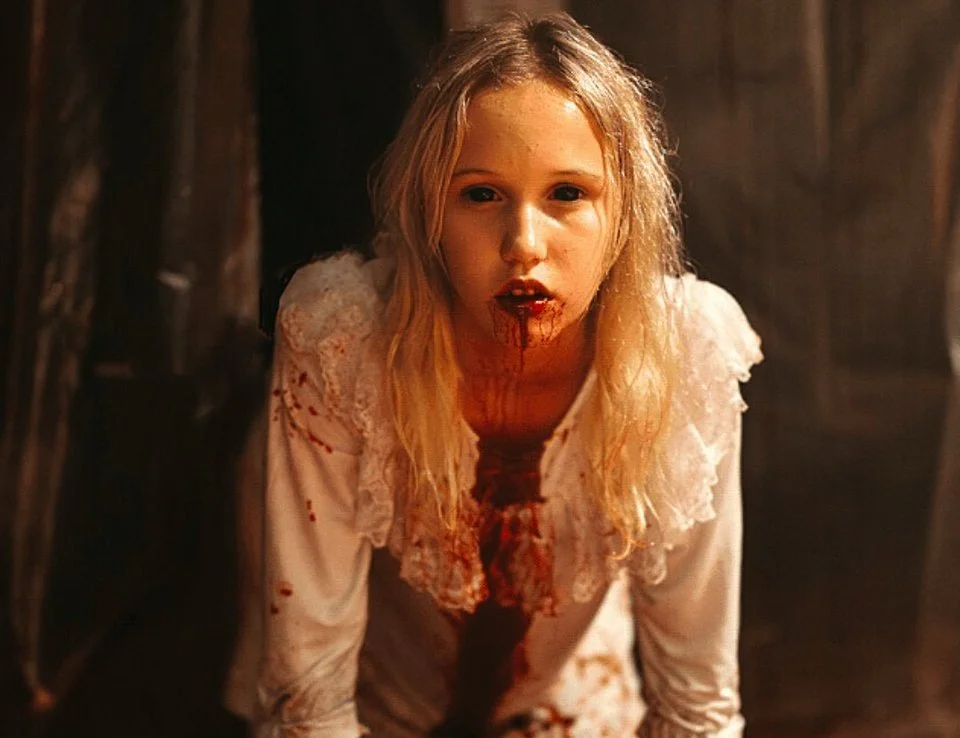
RICHARD WILLIAMS - It was the story first. I sort of split it into two different screenplays, and that was the first one I wanted to tackle. The idea of this ghostly little girl in a dark forest is something that has stuck with me since I was a kid. I saw the front page of an illustration on a novel that sort of inspired that, and then as an independent filmmaker, you really want to set yourself apart if you want to do horror in the forest. Well, in what way has that not been done yet? And that's where the whole first-person POV thing came into it.
You set yourself quite a task for directing a film in this fashion.
RW - I did make a very very small feature (WHITE BLOOD), which is technically my debut. So that was sort of my, I don't want to say practice, but practice run. And I've been working in the commercial world for you know eight or so years, and I'd been to uni. I knew my way around things, and I really wanted to just really try something here. None of us had experienced it. No one's ever shot a film, a full feature, the way we shot it on the Sony Venice using the Rialto rig. So, we really hamstrung ourselves there. But you know, we've been to South by Southwest, and now we’re at FrightFest so it seems to have paid off.
And were video games an influence at all, or were you more influenced by film or anything else?
RW - When I was formulating this film, I'm a big film buff and I play a lot of video games, but I hadn't really put the two together until I was working out the blocking and the shot list and everything, and I was like, "Ah, crap! Yep, I'm going to have to go back and play a lot of these video games.” A lot of the sort of creature work in the forest was sort of inspired by a few video games like The Forest, Slender Man. That was a game that I sort of referenced in some of the scares. You know, how do you block a scare when it's all POV and you can't really hide? You know, you can't cut to hide stuff, so that's where I got that from.
I watch a lot of horror films obviously, and I don't say this lightly, but I never fall for jump scares, but you did get me with your first one here.
RW - Some people hate me for that, they're like, God damn you! It's one of those sort of somewhat sadistic things to do as a director in a POV format. It hearkens back to those old internet videos with the jump scares. That was truly an inspiration for that.
Is First Person POV a route that you want to keep on following, or do you want to go in a more formal direction for your next project?
RW - I've got a few in the pipeline, but since we've mastered this sort of way of shooting and worked out all the kinks of it, it'd be a definite shame to just drop it all of a sudden. But on the other side you don't want to get too funneled into it. It is a tough way to shoot. It is a very tough way to shoot. just being restricted in your blocking and being forced into a certain way, especially with horror. But on the other side of that, I think it enhances the horror, and it's a crazy thing that it hasn't been done more before, and if there's an opportunity. Then we will see. I've already written a sort of anthological sequel to this, and if there's an opportunity to make that, I’ll definitely jump at it. Since making the movie I’ve played a lot more Resident Evil because everyone says this is so much like that, and it sort of inspired a lot more things. So maybe I need to make a sequel, and maybe I need to push things even further.
And did you encounter any difficulties in filming and then in post-production? I can't imagine what your kind of camera rig was like.
RW - If you go to our Instagram, you'll see the rig. It actually got featured by Sony recently. It's the Sony Venice cinema camera with the Rialto detachable sensor. You've got this big cinema camera on someone's backpack, and then that's wired to someone wearing a helmet with the sensor in it. So those two people make up the camera, and then you've got the actor running around doing all the voice and acting against our actors, and then you've got the boom off. So you can imagine it. I think the second scene is an eight minute shot, and we move about 300 meters through this forest, like stuff like that. It was very fun, very intense, and you know you're going to be shooting 360 degrees, so you have to hide a lot of stuff as well. So yeah, it's a difficult way of shooting, but it's a quick way of shooting.
How was it filming in that particular part of the Bush late at night?
RW - Recording in the Australian bush, you know, I've got some friends from the UK who think it's dangerous to walk about. But I use that sort of fear, especially in the film. It's sort of fear of the unknown, and people around the world seem to think Australia is pretty dangerous, but you know that's not something I'm going to dispel. But it was fun bringing all the actors out into this forest. A few of them are from interstate, and not everyone lives close to the bush in Australia. They were on edge as well, which is good. It's like another thing as a sadistic director, you don't just want the audience to be on edge. You want your actors to be on edge.
I wanted to ask you about specific influences you had for this film.
RW - The shooting sort of influence, 1917 was one of those where you know you had to sort of work at this you one shot. BIRDMAN as well. As much as you think it's just you're going into a POV film, and that's going to be the basis of it. But it is also working with a single shot and trying to make the scene dynamic and interesting, get exposition out in these long one shots, and also make it scary at the same time. Maybe they are not necessarily inspiration, but that's sort of where I sort of built from. What sort of inspires that horror? THE HILLS HAVE EYES and there's a bit of THE TEXAS CHAIN SAW MASSACRE. Then in terms of video games, obviously there's games like PT, the playable teaser that came out for Silent Hill. That was a big one, and those first person horrors like Outlast and like I said The Forest. That inspired a lot of the scares and how to do the scares in first person.
You're one of a few films from Australia that are playing the festival this year. Do you think that there's a bit of a renaissance going now with Australian genre filmmaking?
RW - I hope so. I really do. I love the Ozploitation of the 70s, 80s. I'd love to be a part of a new generation of that. With what's happening in our sort of space it's funny that what seems to be taking off internationally is our horror. I think the world loves our sort of depraved sort of mentality around cinema. It seems, you know, dramas not so much, but our horrors seem to travel well.
And are you coming up to Fright Fest yourself?
RW - Yeah, I'm very excited. I'll be at the screening, doing a Q and A. So people can ask me questions in person about how the hell we did this thing, which I love.
Iain MacLeod
DEAD EYES - UK PREMIERE
DISCOVERY SCREEN 2 - FRIDAY 28TH AUGUST, 10:45AM