
IN CONVERSATION WITH JAMES HUNTER & LUCY LOVEGROVE
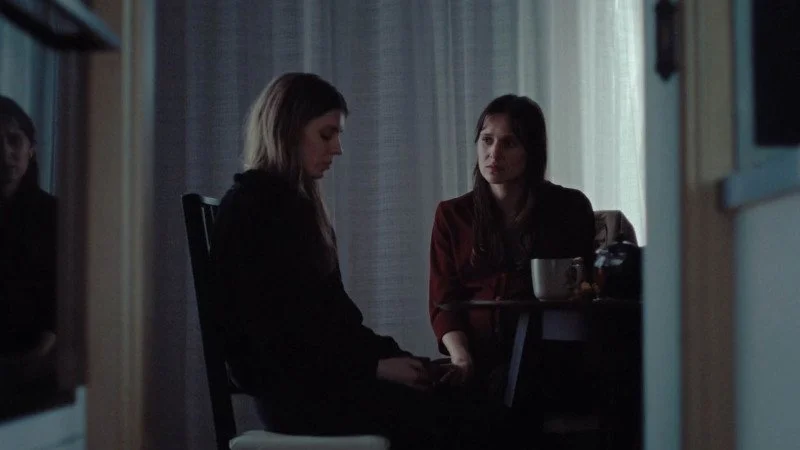
Australian filmmaker James Hunter makes his feature debut with The Latcher, an atmospheric psychological horror exploring themes of grief, isolation and the darker side of the human experience. Gore In The Store spoke to James and lead actress Lucy Lovegrove about making the film, the directorial decisions behind its distinctive visual style, their approach to horror, the inspirations behind the story and bringing their vision to life for audiences at Tubi FrightFest.
GORE IN THE STORE - Why did you choose to shoot the film in the square 4:3 ratio? Do you think it lends itself to the genre in a certain way?
JAMES HUNTER - It’s an unusual choice I suppose. My cinematographer, Alex Serafini, and I had a lot of discussions about that early on. It’s a format that I’m not estranged to, my previous short film NEST was also shot in a 4:3 aspect ratio which suited that particular story because of the height of the trees. It was set in the Australian bush, and we wanted to convey a sense of this character in that story being dwarfed by nature. But I understand that it's quite an unusual choice for a feature in 2026. However, I'd seen it done a couple of times before in some films that I loved, like THE LIGHTHOUSE, the Robert Eggers film, as well as YOU WON’T BE ALONE, which is by another Australian filmmaker, Goren Stolevski. I personally just aesthetically love that look, but we had to have a reason for it in this particular story as well, and because this story is a psychological horror, it is also a portrait of grief, and sort of a portrait frame for Lucy's face because it's so focused on her character throughout. That really appealed to us with the rushes that we were getting back. We also really liked the idea of the sort of walls closing in on her as the story went on, and we felt that the aspect ratio sort of heightened that effect as the story unfolds.
Did either of you have any connection to midwifery before this?
JH - I learnt this purely by happenstance making this film that I have a relative who's a bereavement midwife. She's actually a second cousin of mine, so my mother put me in touch. She connected Lucy, and me, and the co-writer Brodie Marchant. We all had some really great interviews with her and with another midwife to sort of help with the research around this story. But did you want to speak a little bit to that, Lucy?
LUCY LOVEGROVE - I think in another life I would have loved to have been a midwife. I've always been obsessed with the show One Born Every Minute. I was so devastated when it finished, and now I've read that it's coming back. It basically follows maternity units and midwives in different hospitals around the UK, and you really get a great sense of what it's like to be a midwife, and you get to see how lots of different couples experience and how they handle birth and how the midwives have to adapt to whatever situation that arises on their shift. So, that's probably my main connection with it. But I had to do a lot of research, you know, and watch a lot of birth-related stuff and midwife-related research in order to take on the role. It was so useful having the midwife consultant that we did have, give us feedback on the script, and we actually made changes to some of the scenes based on her feedback. She was fantastic to have on set with us for particular scenes to help me make sure that I was actually behaving and touching in a way that is realistic for a midwife and asking the right questions and so on. So yeah, that's probably our connection with midwifery.
JH - And I would add that Lucy and I talked a lot about the connection of the mind-body connection that midwives have, historically speaking. This sort of connection to nature, to do with the body and female anatomy, and so they were conversations Lucy and I had because we really wanted the film to have that sort of very tactile, very organic feeling. Like we're kind of trapped in Alice's body and mind throughout the story. So that sort of mind-body connection, especially in a psychological horror, felt really right to us with her being a midwife as well.
And where did the idea for the character of the Latcher itself come from?
JH - That's a tricky one to go into too much detail without giving too much away. But I was very much inspired by folklore and fairy tales. The deeper my research sort of went into the history of midwifery and seeing certain points of connection throughout history with, and this is a whole other film I think, back to the witch trials and connected to women throughout history and then the men kind of coming in and taking on more of that role. So there were these really interesting sort of historical anecdotes which we picked up on and were inspired by. But I would very much say that it's a collaboration with the sort of research that we did in our own imaginations and that sort of fertile ground that we were playing in, in terms of looking at supernatural horror films that we loved, but also tracing it back to some folkloric elements and some specific sort of fairy tales with these child snatching creatures or supernatural entities or what have you. That to us was a very creepy and very fertile ground to play in.
The film really gets into its themes of grief and loneliness. Are these aspects that either of you were especially keen on exploring?
JH - Certainly for me, I can say I've definitely got, not necessarily a conscious interest in it, but I do find myself subconsciously drawn back to these sorts of stories again and again. Characters that are isolated are something that I seem to keep coming back to, certainly in terms of the sort of loneliness and the isolation of Alice. It's almost a bit tiresome or something at this point to keep talking about COVID, but because it happened like so recently, we all had this collective experience of isolation and loneliness, where we were all forced, whether we liked it or not, onto our devices or using apps to distract ourselves from our the pain that we were feeling, or the anxiety that we were feeling, or the loneliness that we were feeling, so I felt that Alice had a very universal sort of relatability.
LL - I was also going to bring up the the COVID point, but I think another element that came through the film was the fact that Alice is American, living in Australia, and is not only physically isolated from her own support systems back home, which I can relate to, having lived overseas a few times in my life. It can be a real struggle to forge networks and friendships and that sort of thing. But then, in Alice's case, to have developed those supports with the family that she creates, and then to suddenly not have that again on top of the physical isolation and the cultural isolation it's probably one of the the major themes in the film. And on top of all that, of course, she's living in the middle of nowhere, and it's bleak! It's autumn, winter! It's sort of everything piling on top of her at once, really.
Just to touch on the isolation aspect a bit more. The location itself was out in the bush?
JH - The director of photography, Alex (Serafini) and I live in the northern suburbs of Melbourne, and it's kind of semi rural. I mean, it's not too hard to drive a little bit out, and then suddenly you're just surrounded by woodland and bush, and so we were very inspired. We would kind of go on these drives together, and we'd have conversations about the dead trees everywhere in the middle of winter, and the the bleakness that Lucy was speaking about, and the sort of feeling that that gave, and really thinking that that is not necessarily a part of Australian films that a lot of people associate with Australia. A lot of the time, we associate the hot desert heat or the the kind of sunny bush and this dry kind of feeling. Certainly with living in Melbourne and living in this kind of semi rural environment, it's kind of a different experience of Australia than I think potentially is depicted to the rest of the world in terms of Australian film. So Alex and I were very interested in that. Both of our tastes kind of lean into the European kind of sensibility, anyways. And then, going out doing some of that test footage with Lucy with that 4:3 aspect ratio and seeing her as a part of nature. A lot of the early creative conversations that Lucy and I had were to do with paintings and looking at women through history and in paintings out in nature, and then supernatural sort of figures appearing in the dark. These sort of sleep paralysis demons hiding in the shadows. And so a lot of those ideas were sort of factored back into the inspiration of this film.
For a debut film I was really impressed by how you avoided a lot of the cheap gags like jump scares. I was wondering if for either of you, was there any kind of horror cliches or aspects that you were actively trying to avoid, and did you ever catch yourselves falling into them?
JH - Yes, absolutely, 100% There were a number of horror trappings, I guess, or cliches that we were actively trying to avoid. I mean, one of the big ones I can remember all throughout the process, but certainly I was proud that I kind of held firm on this throughout was not showing too much because I think too often horrors will really grab you with their atmosphere and they're sort of alluding to something, and that's when I'll be really hooked in as an audience member, and then by the third act, I'm just not scared because I've seen too much and I know too much, and that was a tricky one. As the film sort of progressed to work out where that balance was, but I remember we had a, without giving too much away, we have a creature in our story. It's sort of hidden in the shadows for most of the film, and it was a real test of discipline to not reveal too much of that because obviously it's a tiny budget film, and we were putting money into the prosthetics creation or that aspect of the creature design, and it's like doing little test screenings with friends and family, figuring out how much is too much to show, or how little is too little, where they kind of can't, pun intended, latch on to what it is that we're trying to do. So it was a fine sort of balancing act.
LL - Do you remember, James? You were determined not to let me see the creature until my character's first scene with it, and I'm not a horror fan because I'm way too sensitive. I get way too scared, with the adrenaline and dread. Let me tell you, that was building up in me in anticipation of having this real reaction to seeing the creature for the first time. But then, in the end, you accidentally spoiled it for yourself by passing me a laptop to use as a prop in a different scene, and I think I saw a photo of it, and I'm so glad I did though, because I don't know if I would have been able to perform. I would have been way too scared. The only other thing I would say in terms of tropes that we were trying to avoid, and this is more maybe me trying to avoid than James trying to avoid, but I was really wanting to be very conscious about when we were having to scream because I just feel in so many movies, women screaming is so overdone. It just feels really fake, like it can feel really lazy. In realistic scenarios, you're not necessarily going to scream. Like sometimes you just aren't going to have a voice at all, or sometimes it's a gasp, or it's this, or it's that. But I feel like women screaming has become such a thing. So I was quite initially resistant to do that in this film, and James was very patient with me, and I think we ended up doing it really well in the film. And when we do use it, it's great. But that was something I was conscious of when approaching the film.
JH - I didn't actually know that, Lucy, but it makes a lot of sense. It's that whole thing where it works so much more because of that restraint of when it is used. It just loses its effect if you overuse it. But just one other thing that I just thought of when Lucy was saying that was that as we were discovering Lucy's performance over the course of making this film, because we were assembling the film as we were shooting. But because we're shooting it all out of order, you know, as most films do, it was very hard to get a grasp on whether this was going to all come together and work or not. And so I really wanted to figure out what was this film that we were making. And as I was watching it come together in the assembly, I realised that Lucy's our north star. She's doing something amazing here. That is working. That is tracking. That's going to work. But the other thing that I realized about Lucy's performance was it reminded me. I kept thinking of what reference do I sort of have in my you know film memory of like from horror films of like the type of performance that Lucy's giving. And the ones that I kept coming back to were the Japanese horrors and Asian horror cinema and the female performances in that, which often felt very understated, very kind of subtle, but very chilling as well. And so, when Lucy was speaking about that, it made me realize that maybe some of those choices that she was making were really reminding me of some of the Asian horror cinema that I was really inspired by when we were making the film.
The film is part of a group of Australian films that are playing at the festival this year. I was wondering if both of you there's a kind of genre renaissance happening in Australia just now, and how it feels to be a part of that potentially?
JH - I certainly hope so. I mean, I feel horror is definitely having a moment with BACKROOMS, HOKUM and OBSESSION. I'm already sort of hearing just in the industry “Oh, it's having a resurgence, horror's back, baby!” and I always kind of laugh at that because I feel like horror is always around, and low budget horrors are always doing amazing things. It just sort of happens in cycles throughout horror history. But yeah, I would love to see a lot more horror films come out of Australia. I think we have some fantastic horror films here. I mean, maybe they're not even necessarily films that people would always, you know, classify as sort of capital H horror films. But they're the kind of films that I love. Like PICNIC AT HANGING ROCK is one of the eeriest films that I've ever seen. The atmosphere in that film is just unparalleled, and THE BABADOOK and LAKE MUNGO. I mean, there's just a lot of fantastic Australian films, which I think punch far above their weight, and I think it's probably no secret to say they're often celebrated much more overseas, like in the UK and the US, than they are in Australia. I think some of that has to do with our tall poppy syndrome here, but some of it as well has to do with, as I was alluding to earlier we're not really always known for our gothic stories, we're sometimes more associated with these classic comedies or these films set in the Outback and four quadrant kind of films so I think there's always interesting Australian filmmakers wanting to do interesting things here and wanting to push the the boundaries. So I think I probably speak for me and Lucy when I say we're very proud to be one of the Aussie films going to FrightFest this year.
Is this genre something that either of you are going to continue with, or are you looking elsewhere for future projects now?
JH - One hundred percent! IThis genre will always be near and dear to my heart, and I think it probably holds a special place in both my heart and Lucy’s. Now that it's our debut feature film as director and lead actress, I don't think it's anything that either of us feel like you just make one and then you kind of move away from it. It's like there's always more interesting things to explore in this genre. It's such a varied genre. I think a lot of people, when they hear horror, they think of one type of thing. I think that horror is just so varied. The horror that I'm interested in, that more sort of psychological realm, they're just such incredible films.Regardless of being horror films, they're just incredible films in general. And so, I always think genre is an interesting lens to explore dramatic stories in. And to Lucy's credit, and some of the great actors that we had on this film were always challenging me to really find the dramatic heart of this particular story. I think there's amazing opportunities, with what you can do with a dramatic story. If you've got a great dramatic foundation within a genre context, it just excites me more, you know, to the possibilities of that and the creativity in that.
LL - I think for me, prior to this, I would have never necessarily thought of myself as ever being in a horror movie, just given that I can hardly watch them. I just get so hooked on movies and just really put myself into them. I'm a pretty terrible person to watch a movie with, to be honest. But I have to say, James really opened my eyes to what horror could be and to how varied it is as a genre. So I think I would absolutely do another one. But I would love to do a comedy or something else in between.
JH - A little palate cleanser in between.
LL - Yeah, a palate cleanser. That would be nice.
Iain MacLeod
THE LATCHER - INTERNATIONAL PREMIERE
DISCOVERY SCREEN 1 - FRIDAY 28TH AUGUST, 10:50 PM