
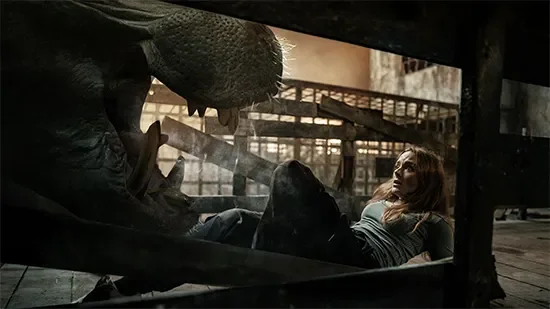
After the action stylings of the ONE SHOT trilogy, writer and director James Nunn, returns to horror, and FrightFest, with HUNGRY. Telling the tale of a group of unlucky tourists trapped in the Bayou with a large, angry hippopotamus with a taste for flesh. Gore In The Store met with James to discuss creature features, the challenges of filming on the water and his return to the festival itself.
GORE IN THE STORE - When did you first have the idea to do a creature feature with a hippopotamus?
JAMES NUNN - So actually, what happened is I was the second unit director on 47 METRES DOWN about 10 years ago, and I just fell in love with making this shark movie. It did very well. It was directed by Johannes Roberts, and I was like, I need to make my own creature feature, but I wanted to make an original one. I didn't want to make a shark one. I didn't want to make an alligator one. I didn't want to make it with bears. I didn't want to make a lion one. I wanted to try and find an animal that nobody had sort of done before. So I Googled what are the most vicious, violent creatures in the animal kingdom, and the hippo is very high on that list. Not a lot of people know, but they kill over 500 people a year. It's a very sketchy number; it can go up to 2000 a year, but document records aren't particularly well kept in these rural areas in Africa, so they don't really know. But they are far more violent than sharks, far more violent than elephants and lions and all those combined. So I just thought “Right, hippo's my animal.” And then I'm a big fan of JURASSIC PARK and the kind of creature movies that are grounded in some kind of scientific reality, I suppose. So I was trying to find a way to get hippos in America because American movies generally sort of do a bit better, and it's a market I work in. And then I discovered this really interesting fact that hippos that nearly came to Louisiana in 1910 during the meat crisis. They were going to ranch hippos to replace the fact that they didn't have enough cows and they couldn't feed enough beef to people, so they were going to sell hippo meat, and it very nearly happened. It didn't, but my thinking for my world was that it did happen, and that's kind of how I put hippos in America.
You just kind of touched on there about how you were so keen to do a creature feature, and I was just wondering what your particular affinity for them was?
JN - Well, JURASSIC PARK is my favorite movie, and JAWS is my second favorite movie. And then there’s the movies I enjoyed growing up. I'm from the DVD era of the 90s, and movies like ANACONDA, ARACHNOPHOBIA, DEEP BLUE SEA and CONGO. These were things that I would watch in my early teens, and just laugh and obsess over, and so that just gave me a love for that kind of movie.
Are you tempted to go the James Cameron route with a sequel and just add an extra couple of letters on at the end?
JN - Well, I don't know if you've seen my other sequels, but I've done ONE SHOT, ONE MORE SHOT, and ONE LAST SHOT. So I suspect if we do HUNGRY, maybe we do HUNGRIER.
Did filming in the water for so much of the film and combining FX work with that, provide more of a challenge to you than usual?
JN - Fortunately, as I said, I second unit directed 47 METERS DOWN and 47 METERS DOWN: UNCAGED, so I'd already done quite a lot of underwater work, and that was actually one thing that drew me to wanting to do this movie because I actually love shooting in the water. I also shot and directed a shark movie called SHARK BAIT, which was set entirely on a jet ski in the ocean. So, I've done three water movies. I'm very versed in it, and it's so fun. Especially shooting in these kind of Mediterranean or South American places where they have these ginormous water tanks. It is just a fun way to shoot a movie. It feels like classic movie making, as opposed to a lot of my London gangster stuff, which is just usually in dark pool halls or bars in decaying London. So it's really nice to get out somewhere with a bit of sun. But that does obviously come with logistical problems and things. It's the stuff that you don't know that might happen that really catches up with you and can take you by surprise. For example, when we came to flip the boat, there's a sequence in the movie where the seven passengers on the tour boat get flipped into the water, and the actual cast were never going to do that stunt because we had got stunt people to do it. It's kind of dangerous so the original cast were going to be bumped from below, so that they would flinch and feel it, which happened. And after two bumps, it was going great, and then the third bump, a rogue wave kind of dunked a load of water into the flat bottom boat, which meant when they went for the fourth dunk, it actually went too high, and the boat with the cast was too heavy, and did end up flipping into the water taking the seven members of cast into the water with it. I mean, it's still safe to a degree because you're still going to put stuntmen in it, but we weren't expecting the real cast to go into the water, and they did. Fortunately, they were all good sports about it. But we did end up blowing a lot of radio mics that shouldn't have gone into the water.
I also wanted to ask how you compare the filming of something like this to the likes of TOWER BLOCK and the ONE SHOT films?
JN - Yeah, very different methodologies, especially with ONE SHOT, which is obviously principally shot with one camera and long scenes, where we disguise the cuts, to make it feel seamless, like one long movie. Whereas this movie is an ensemble piece, with seven people talking, all in trees, all over the water. I mean, it would have been physically impossible to fly the camera around and do it in the same methodology. But there were lessons I'd learned from these kind of long takes from ONE SHOT because the one thing that one long take does is, it sort of increases tension and suspense and there are a couple of sequences in HUNGRY where we run the camera long, unbroken, to increase that kind of tense atmosphere in the same way that ONE SHOT does. But they're very, very different mindsets. TOWER BLOCK is much more similar to HUNGRY in the sense that it is also an ensemble piece set in a tower block. I think it was nine cast members, each having their own conversations and getting picked off one by one. So TOWER BLOCK’s a lot similar in the sense that it's traditional movie making. The added difficulty on HUNGRY is that it's wet and dry as opposed to just dry.
This film is more tension based than action based. Was this a deliberate choice for you as a writer and director?
JN - I think the truth is, I've always seen myself as a thriller director. When you look at TOWER BLOCK, it is a horror thriller. And when you look at my action stuff, there are thriller elements in there. My favorite movies are COLLATERAL, END OF WATCH and ENEMY OF THE STATE. So I think when I write, I tend to gravitate to writing thriller stuff, and that's kind of just where my brain went with HUNGRY . So it's not too far out of my comfort zone. I think if I was to try and do something like, let's say, a comedy, I'd be drowning because I have no idea how to make people laugh but I know how to kill people on camera.
What are your influences for this film and in general?
JN - It's a bit of a love letter to JURASSIC PARK, really. For those film fans who really love that movie, you're going to notice some lines of dialog that pay homage to it. There are also a couple of shots that pay homage to it. If you stick around and watch it all the way through, the very last shot is very similar to the last shot of JURASSIC PARK. So there's some subtextual, subconscious stuff going on there where I'm trying to be Steven Spielberg on a budget.
I also wanted to know if you had any pushback at all from Hasbro concerning your hungry hippo?
JN - No, no pushback from Hasbro. They don't own the word hungry, so they haven't pushed back. To my knowledge, they haven't made contact with the distributors or the sales team. But if they did, then I don't even know if I would hear about it, to be honest. So, currently no. The movie was actually supposed to be called The Bayou, but unfortunately, that was taken by another alligator movie about two years ago. So we had to pivot, and coming up with titles and movies is hard, you know. I suppose we could have called it hippo with an exclamation mark!
If you had an unlimited budget and all the resources that you could get, are there any other creatures that you'd like to take a shot at film-wise?
JN - Oh my god! Yeah, I mean, look, if you have an unlimited budget, there's so many movies I want to make. I guess I'd be making Noah's Ark, but like the horror mode, but with every single animal!
Is this your first time coming back to Fright Fest since 2012 with Tower Block?
JN - Well, first time with a movie. I've obviously been there as a fan for many years. TOWER BLOCK closed the festival in 2012, which is 14 years ago now. So I haven't had another movie in the festival, but I have been as a fan and seen so many movies over the years for sure.
And was FRIGHTFEST helpful to your career at all with TOWER BLOCK?
JN - 100% I will gush about Fright Fest till the cows come home. It was an incredible debut for my very first movie to have such a prestigious screening, and the festival means a lot to me because of that one screening, but also because of the friends and fans and filmmakers that I've met at the festival before and since. I think it's a real filmmakers festival, especially if you're a UK film director. You know the best movies that come into town, that are kind of in my wheelhouse of taste end up at FrightFest if they're worth their salt so it's a real honor to be back at the festival this year and to have been given such a prestigious slot, you know? Friday night, 11 p.m. is like the perfect screening for a creature feature movie to a horror crowd. So yeah, I'm over the moon about it, and I'll be there to intro it and do a Q and A and stuff, and I can't wait.
Iain MacLeod
HUNGRY - ENGLISH PREMIERE
TUBI MAIN SCREEN - FRIDAY 28TH AUGUST, 10:55 PM