
****
Directed by David Fincher.
Starring Brad Pitt, Elizabeth Debicki, Scott Caan.
Thriller, US, 140 Minutes, Certificate 15.
Released in Cinemas in the UK on November 25th.
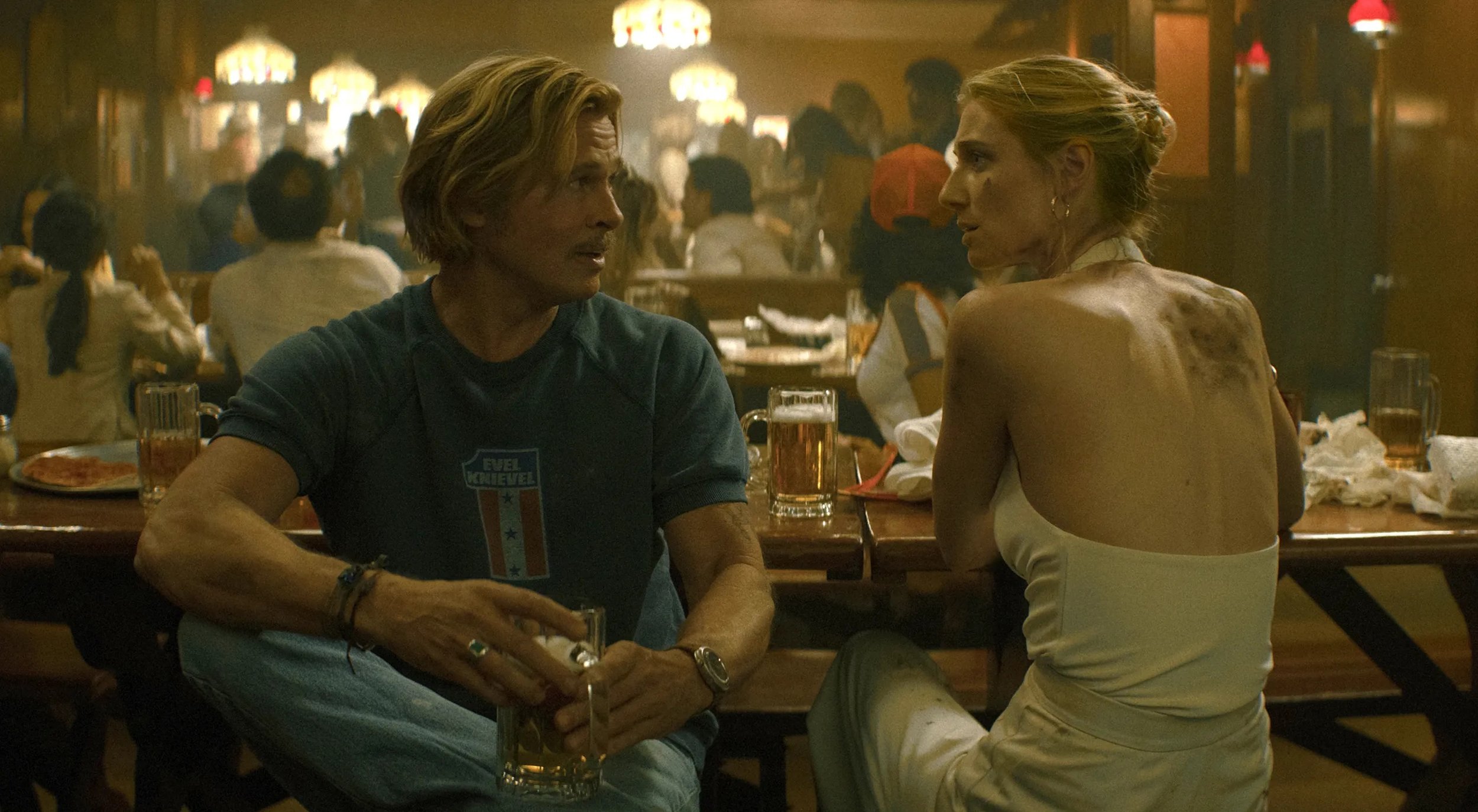
Eight years after teaching a bunch of murderous hippies not to mess with his neighbours, Cliff Booth is still living the low end of the Hollywood dream. With Rick Dalton piling on the pounds down under, Cliff whiles away the nights either taking over projection duties in the New Beverley Cinema or pouring margaritas and charming the clientele at a local bar across town. These easy going activities are completed with an after hours side hustle, acting as a kind of off the books showbiz enforcer, making sure the talents dirty little secrets remain in the dark. As ruthless as he is charming however, Cliff’s latest task, involving a diminutive, hot-headed TV star and his reneging on a deal with two cold-blooded Filipino gangsters really could put a kink in his otherwise laidback life and burgeoning relationship with a no-nonsense talent agent.
While we wait for Tarantino’s supposedly final film, this revisit to one of his most complex characters, in collaboration with director David Fincher, fills in the gap nicely. It may feel like an odd match; Tarantino’s freewheeling, shaggy storytelling tics up against Fincher’s meticulous visual style which seems more suited to psychologically troubled and obsessed individuals. A regular collaborator to both filmmakers, Brad Pitt seems to be the bridge between the two filmmakers here. Fincher’s distinctive style is still his own, while Tarantino’s own unmistakable voice rings through as clear as a bell, while Pitt coasts through on the charm and simmering threat of violence of the character that won him an Oscar back in 2020, in exactly the same style. Pitt’s titular character is also at the centre of everything, and everyone, here. The cast of fictional actors, directors, old flames and lovestruck females who drift into his orbit; charmed and beguiled by his no-nonsense wisdom in a city where everyone is pretending to be someone else. The only character not impressed, perhaps because he knows him the most is his own gruff father Gus, a pawn shop owner who maybe loves the movies more than his son and but has next to no time for his long winded anecdotes.
The performances are strong across the board. Scott Caan, as hot headed TV actor Charlie Peters, channels the aggressive nature that made his father such a memorable actor, while Elizabeth Debicki impresses even more as Caan’s put upon agent. Her unflappable nature coming close to slipping away when subjected to Cliff’s romantic advances make her an excellent foil to Pitt, who gives his best performance since the last time he played Booth. Fans of the first film will also no doubt be surprised and delighted by a number of small appearances by familiar faces popping up in their late 70’s guises.
The film does have a flaw, and sadly it is a pretty unforgiving one, especially for a director like Fincher who has made a reputation for driving his cast and crew mad with his visual stylings. Generative AI has been used for a number of scenes, as well as post-production tinkering in manipulating actors voices and lip movements. The latter may not pop off the screen, but the former most definitely does, especially in the sequence detailing Charlie Peter’s television career, the oversmoothed and hyperactive “acting” and reactions of the prompt driven extras and unconvincing locations is painful to look at. It is mystifying as to how Fincher let such shoddy work, including what appears to be a horse attached the wrong way to a carriage while the riders sits backwards, that is far worse than the usual CGI that blights many other films. Where ONCE UPON A TIME IN HOLLYWOOD went to great lengths to convert whole streets and swathes of road of Hollywood back to a late 60’s setting in great detail, this film is content to sit Pitt in front of an otherwise unconvincing simulated backdrop while an offscreen fan blows his hair around in an attempt to fool us. It also feels like a slap in the face to Finch’s regular cinematographer Erik Messerschmidt who when he is allowed to here, conjures up some evocative and atmospheric work that captures the wind blown and sun kissed nature of LA and its various nightclubs, bars, tennis clubs, dusk lit beaches and floodlit demolition derbies.
While it is a disappointing aspect, the strength of the script and its performances more than carry the film. It could still count as Fincher's best film in years and his most purely enjoyable film, perhaps since FIGHT CLUB. Like Tarantino’s best works, it all wraps up in a tension filled showdown that plays out in a chaotic fashion after its romantic and nostalgic stylings. Far more than just another Netflix vanity project, it justifies its existence on a number of levels and proves itself as one of the most purely entertaining films of the year and fills in the gap nicely until Tarantino draws the curtain on his own cinematic career.
Iain MacLeod