
TEENAGE SEX AND DEATH AT CAMP MIASMA
***
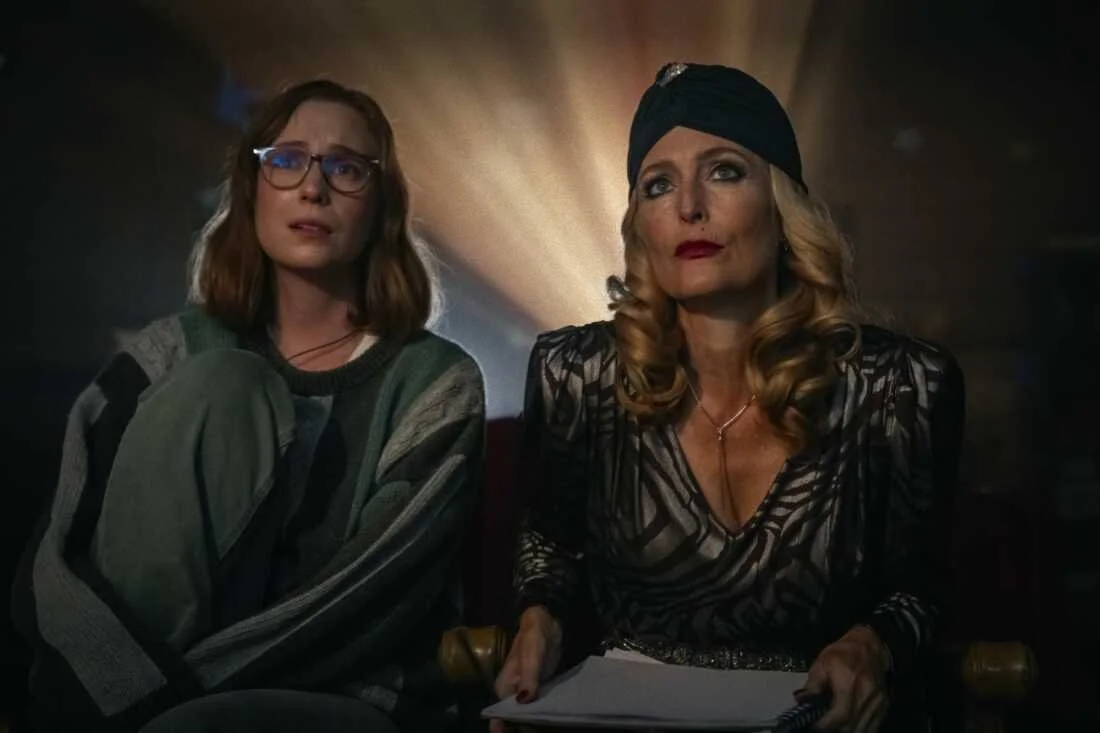
Directed by Jane Schoenbrun.
Starring Hannah Einbinder, Gillian Anderson, Jack Haven.
Horror, US, 112 Minutes, Certificate 15.
Released in Cinemas in the UK on August 21st by MUBI.
After endless sequels, reboots, parodies, re-interpretations and all manner of academic examinations, what more can be said and done with the slasher genre? For something so simple and seemingly basic there certainly is a vast amount of material to help you navigate and tackle the various issues that are brought up by the likes of SLUMBER PARTY MASSACRE and/or SLEEPAWAY CAMP and their transgressive/problematic/subversive natures. (Choose the most applicable option.) Arriving on a wave of hype, aimed mainly at the arthouse crowd, Jane Schoenbrun’s bluntly and parodically titled love letter to the genre arrives on screens. After their impressive and original breakout hit I SAW THE TV GLOW, forged their distinctive voice in such an affecting and original manner, the opportunity for them to tackle a genre forged with such problematic and outdated tropes is an enticing one that could go in so many directions. Rest assured, Schoenbrun, certainly does take their tale of a camp dwelling masked murderer to somewhere entirely unexpected.
From the distinctive font to the poster/VHS cover imagery of various heroines wandering dark forests that is put on display so prominently in the credit sequence, the titular franchise at the heart of the matter here is very obviously modelled on FRIDAY THE 13TH and its many sequels, TV spin-offs and endless merchandise. Once a hit with its early sequels, the CAMP MIASMA franchise, with its air vent masked, spear wielding villain Little Death, has drifted into irrelevance. Enter young, queer filmmaker Kris Williams (Einbinder), a director whose minor Sundance hit was most notable for telling a large portion of its PSYCHO like tale of being told from the perspective of the shower curtain. Nervous that she is only being used as a token minority by the studios to bring the slasher saga back into social, and financial, relevance, Kris has a heartfelt desire to make a personal film which honours the franchise she holds so deeply in her heart. To do this, Kris ventures into the snowy wilderness to track down the original film's now reclusive star Billy Presley (Anderson), to star in her heartfelt and distinctive take on Little Death’s return. Surprised to find Billy living in a replica of the first film’s camp setting, Kris is soon unsettled then enticed by Billy’s stating of fact that Little Death lives at the bottom of the lake by the camp, ready to rise again.
Compared to Schoenbrun’s previous works (especially the mumblecore stylings of WE’RE ALL GOING TO THE WORLD’S FAIR) this shows the director having more fun than ever before, indulging their passions for slasher cinema and all of its illicit trappings. At the same time this is still an intensely personal vision, especially in Kris’s backstory, which eventually emerges, and merges with Billy’s, coming to the forefront and revealing their own deeply intimate connections to the film that started everything. Billy’s passion for the franchise is splurted out in nervous yet passionate streams of dialogue that one second praise the films backstory of Little Death then immediately attack it for the transphobic nature in which they were presented. All the while Billy, dressed and presented like a horror cinema take on Norma Desmond, bemusedly and coolly takes in Kris’s academic observations before shooting them down in her deadpan, languid style.
As a double act Einbinder and Anderson offer up an affecting take of fan girl and final girl. Einbinder’s portrayal, which has echoes of her own role in the comedy series HACKS, of a tender character who despite their open nature about their own sexuality shies away from actual physical contact delivered in an appealing naif fashion while Anderson manages to subvert the role of the seductive older woman, not quite a femme fatale but still off kilter enough, to keep Kris, and the audience, suspicious as to their true tie to Little Death and her meta connection to the franchise as a whole.
While fun, this is still primarily an arch exercise in genre deconstruction. Schoenbrun simultaneously pokes fun and celebrates the genre trappings of woodland remote locations and recognisable character archetypes and obligatory origin story told via firepit to great effect in the CAMP MIASMA film within a film. Schoenbrun then indulges in a CGI laden, and Counting Crows soundtracked, extended one-r shot that not only looks at odds with its surroundings but with the genre as a whole. Despite heavy nods to the likes of FRIDAY THE 13TH PART VII: THE NEW BLOOD and others there is an air of arch artificiality, that seems to be aimed squarely at the elevated horror and arthouse crowd to get them onside to show how above it all Schoenbrun and company are, that is in complete opposition to the more tactile elements that make slasher cinema so fun and memorable.
At the same time there is a heartfelt obsession and celebration of genre on display here that otherwise works. The casting of Anderson being the most prominent and obvious, especially for fans of 1990’s genre television, another favourite theme being carried over from Schoenbrun’s previous film. Despite her Southern accent, Anderson never descends into full camp here, instead offering a humorous and fascinating interpretation of the horror genre’s most appealing archetype, the Final Girl.
While the death aspects of the film may be lacking, it is the exploration of sexual territory that leads into areas of fetishisation and acceptance that yields much more interesting, and thornier results. Billy and Kris’s separate experiences are tied together in such a symbiotic way that explores the tangled relationship between viewer and film that has not really been explored onscreen before. On one hand there is an off kilter relationship that is touching, heartfelt and bracingly honest, while on the other there is an academic air of self-satisfaction, undercut by some extreme examples of completely obvious visual metaphors and some shockingly lame self-referential humour, especially in the film’s closing set piece, that keep the viewer at an emotional distance in a way that the director's previous works did not. Despite these missteps, this is still an original work that more than manages to be fun and original in its own offbeat and bloody fashion from a director who continually pushes their themes and styles in ever more interesting ways, while poking fun at themselves and the genre as a whole.
Iain MacLeod