
ROSE OF NEVADA
****
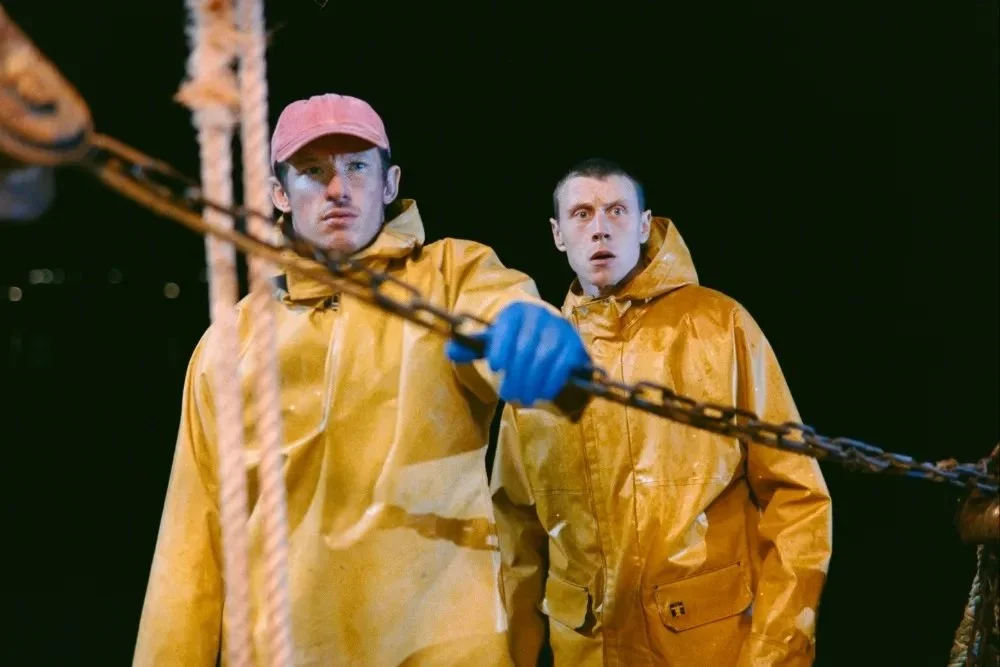
Directed by Mark Jenkins.
Starring George Mackay, Callum Turner, Rosalind Eleazar, Francis Magee.
Drama, UK, 114 Minutes, Certificate 15.
Released in Cinemas in the UK on 24th April by BFI
Reviewed as part of Glasgow Film Festival 2026
The spectre of the past seeps into every frame of Mark Jenkins latest exercise in hauntology. Rust cakes the chains, and steel rings that line the jetties, while the faded and flaking paint on the old pub sign is a mark of how empty it is inside now. The arrival of the titular fishing boat into the small Cornish coastal village where this all takes place is the keystone that brings the past and present crashing together in a number of ways that confounds not only George Mackay and Callum Turner’s fishermen but the viewer too in Jenkin’s exploration of certain genre tropes through a lens misted by allegory, regret and the pull between hoping for a return to better, more comforting times while facing and dealing with the realities of the here and now.
Like his debut film BAIT, Jenkins explores yet again the battle between modernity and tradition, although this time the otherworldly elements that were previously only hinted at, are now on full display to a dizzying, near kaleidoscopic effect where time becomes an even more abstract concept. Mackay plays NIck, out of work, devoted to his girlfriend and young daughter and desperate to repair the hole in the roof where rainwater drips constantly. In contrast, Turner plays Liam, an aimless drifter with no ties to the land he finds himself in. Both desperate to turn their financial woes around, they take jobs as fishermen on the small boat that has somehow reappeared without explanation after going missing over thirty years before. While the boat's boss, played by Jenkins collaborator from BAIT and ENYS MEN, Edward Rowe, realises that something is truly amiss with the mysterious vessel, Nick and Liam are completely in the dark until they return to land. Finding the small village, and dock, a completely bustling hive of activity, they soon realise they have been transported back in time to the early nineteen nineties, where everyone recognises them as the two sailors who went missing with their boat the first time around.
On one hand there is a lot that is familiar here. Fans of Jenkins' style of storytelling, filmed on 16mm film with all dialogue and sound recorded in post-production, will no doubt welcome this distinctive style that goes beyond the usual retro tropes. The sound of the film, sounding like it's being broadcast through an old radio alongside Jenkins discordant electronic score, melds with the visual style: repeated edits, sometimes played backwards and/or upside down with the past, interjected into the future and vice versa, is doubled down on here. Closer in spirit and tone to ENYS MEN than his debut film, it feels, and looks, more impressive when you consider that all this has been done by hand, resulting in a film that feels truly handcrafted. It is a style that still intoxicates and works a strange spell on the viewer.
As well as fans of the director, admirers of vintage folk horror, will no doubt find much to admire here. The mysteries of the film, of which there are many, may need multiple rewatches to truly decipher what is going on here. It is hard also not to feel that the film is a lament for the past with deep regrets for the future we now find ourselves in, partly due to our own making. With fishermen in particular getting hit harder than most after Brexit, the film may feel heavy handed to some viewers, but there is a sense of nostalgia at play here that is easy to identify with. Such a vein of storytelling may lead you to believe that this is Jenkins most accessible film yet, but despite the presence of his starriest cast yet it also manages to be his most oblique and puzzling. While there is a small sense of familiarity creeping in now, at this moment in time, Jenkins style in storytelling is still fresh enough to make you try and unravel the film's many beguiling riddles.
Iain MacLeod