
INSOMNIA
****
Directed by Erik Skjoldbjærg.
Starring Stellan Skarsgård, Sverre Anker Ousdal, Bjørn Floberg.
Thriller, Norway, 97 mins, Certificate 15.
Released on Limited and Standard Edition 4K UHD and Blu-ray in the UK on 25th May by Second Sight Films.
Anyone who has ever suffered from prolonged bouts of insomnia will know how it can mess with your mind, your mood, your relationships. The opening of 1997’s INSOMNIA ironically unfolds like a nightmare infused with the found-footage horror films that, soon after its release, would become commonplace. Stark, grainy Super-8 footage captures the murder of a 17-year old girl, Tanja (Maria Mathiesen). It’s like being shown a video from a serial killer’s private collection, albeit one enhanced with a discordant score by Geir Aule Jenssen - who, in the year of this film’s release, had huge success as “Biosphere” with revered ambient album Substrata. Rapid cut, disarming images capture the “perfectionism” of a killer efficiently removing any trace that might give away his identity: washing the dead girl’s hair, scrubbing her nails.
Tania is subsequently found on a rubbish dump in the city of Tromsø, far North in the Norwegian Arctic, nicknamed “The Land of the Midnight Sun” for reasons that swiftly become clear. Cops from Kripos, Oslo, arrive to find her murderer: former Swedish officer Jonas (Skarsgård) – who has moved to Norway to dodge gossip surrounding an affair with a key witness – and ailing Erik (Sverre Anker Ousdal), who ticks the cop movie “X more days till retirement” cliché box. While Erik makes lame efforts to flirt with much younger women and Jonas seemingly can’t avoid doing the same, a disorientating, dramatically failed attempt to arrest a suspect, author Jon Holt (Bjørn Floberg), ends in tragedy and fractures Jonas’ mental state, alongside the sleep-wrecking perpetual daylight.
Skarsgård is (typically) terrific as the deeply troubled and flawed protagonist at the heart of this taut, intense feature debut for director Skjoldbjærg. A lonely figure who appears to have burned all bridges with previous relationships, he gives little away about a personal life that has become the focus for unflattering speculation, other than the death of his brother when he was a kid. He’s a difficult guy to like, particularly when we witness his two different interactions with much younger girls (one of which almost becomes a sexual assault), but we nonetheless root for him to escape from his personal and professional nightmares.
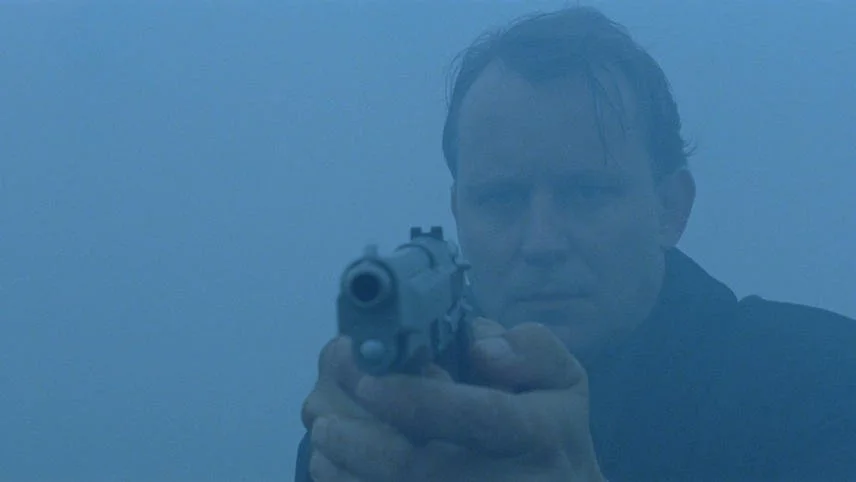
It’s technically superb: Erling Thurmann-Andersen’s alienating cinematography, with its sparse use of colour and desolate landscapes, vividly capture an unforgiving environment: these men might as well be investigating a murder on the surface of the moon. The mist-enshrouded set piece that transforms the manhunt is brilliantly executed, as is the preceding torch-lit cave pursuit. In an era of ingenious, charismatic Hollywood serial killers, Floberg’s portrait of Jon is disturbingly unremarkable and muted. Underplaying a dangerous man who calmly considers his abhorrent crime in relation to his profession (“The fiction became too boring…”), he’s horribly ordinary, not a “killer type” to quote one character. The film fittingly climaxes with an unconventional denouement, refusing to provide the tidy, violent wrap-up audiences had come to expect from the genre.
INSOMNIA’s legacy has been somewhat overshadowed by Christopher Nolan’s excellent 2002 remake starring Al Pacino and Robin Williams, so Second Sight’s new release is a fantastic chance for reappraisal. The new 4K restoration, with Director Approved HDR grade and Dolby Vision, is superb: the cold and murk (morally and otherwise) almost seem to creep into your bones, the icy visual palette immersing us in the protagonist’s escalating disorientation.
The Limited Edition, with beautiful new artwork by Peter Strain, a 120-page book of essays and six collector’s art cards, and a strong range of extra disc features. Erik Skjoldbjærg is joined on a new audio commentary with co-screenwriter Nikolaj Frobenius, while the former provides a comprehensive recollection of the movie’s genesis and production in “Running On Impact” (29 mins). A film student at the time, he recalls the mission to capture an existential crisis within a thriller narrative, noting the influence of 1960s French and Italian films, as well as the use of minimalist backdrops, rules for colours (chilly greens, no yellows) and how the exterior locations mirror the protagonist’s state of mind. The director also touches on his subsequent career – including 2001’s PROZAC NATION - and turning down the remake.
Additionally, Petter J. Borgli talks about his accidental entry into the film business in “Falling Into It” (10 mins), and Alexandra Heller-Nicholas’ typically thoughtful “Private Prisons” (12 mins) celebrates it as a “pioneering Nordic noir” while analysing the visual style and Krimi / giallo influences. Skjoldbjærg’s earlier short films, NEAR WINTER (1993, 33 mins), CLOSE TO HOME (1994, 29 mins) and SPOR (1996, 15 mins) provide a fascinating glimpse of his burgeoning talents and his eye / ear for dread and unease.
Steven West